
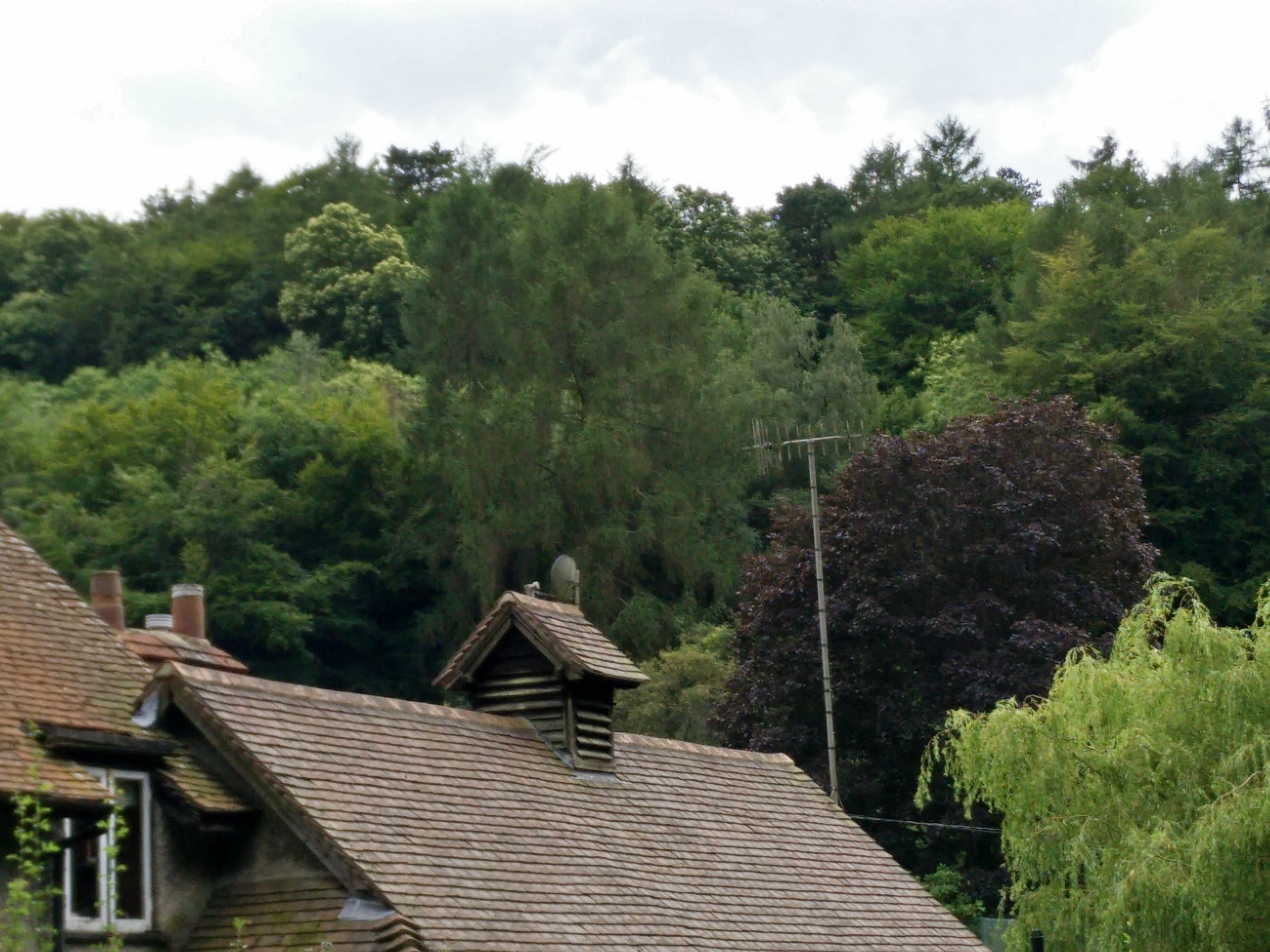
My Irish mother came to work in domestic service for a local GP in the village in the early 1950s. My father had grown up locally in the village. For clarification, my definition of ‘working class’ was that my father was a semi-skilled manual worker, and my mum did manual domestic work, although she would also answer the door and ‘phone to patients for the GP.
The village had been home to rich land owners for centuries, and then the comfortably off and aspirational middle classes started to move in to the beautiful houses built after the First World War. By the 1960s the middle classes with some land or ‘just’ a medium to large garden were fairly prominent in the village. Their children often went to a private prep school instead of the village primary. An exception to this being a family who I believe transcended class: appearing to be neither one class or another, relating well to all people within the local Catholic parish and village community in general. The mother of this family provided support for my own mother when needed and the children were ideal playmates. Furthermore, their children went to state schools.
As a well mannered placid child, I entered both worlds: there was one middle class family that would invite me to be with their children at play. But ‘be with’ was the operative phrase: it was sometimes to watch their children at play, to keep them entertained, but to be sent home if more important playmates arrived suddenly.
However, I could also join the working class children of parents working in service or in manual work locally. This was rough and tumble play where if you didn’t stand up for yourself you were teased or left on the sidelines; but it could be fun – making bracken camps, picnics on one of the highest hills, and street skipping. But I often felt too sensitive to spend time with these more street wise kids: those kids were never invited to ‘play’ with the middle class kids! The class divisions were too set in stone.
If I aspired for what the ‘superior’ classes had got I was firmly told: “That is only for the monied people.” The class divisions of my childhood perturbed me and I was often lost as to what the future held.
Congratulations on a well presented and informative blog. You may have discussed some of these issues with me beforehand but I did not appreciate your strong views about class divisions.
My experience was growing up in a prefab community in East Acton, many miles from the idyllic countryside of Surrey. My childhood in this community was very enjoyable and I did not notice, at first, the clear class divisions that you experienced.
Matters changed for me in July 1958 with the death of my father (at 38) through lung cancer. My mum at the time was faced with a triple whammy of the loss of my dad, from being 5 months pregnant and with my success in passing the 11 plus and earning a place at St Clement Danes grammar school. We were given a grant to meet the considerable expense of a school uniform and allowed free school meals.
I became more aware of our poverty when I started at the school, the few boys who had free meals were in some cases clearly announced. We were very poor in the next few years as my mum could not work until my sister was able to go to nursery. I remember quite clearly the Christmas of 1958; my mum was unable to afford anything special and was delighted on Christmas Eve by a visit from our neighbours who brought us a food hamper including “luxuries” such as chicken and tangerines!
There was a wonderful community spirit in the prefabs. Our neighbours were generally quite poor but would not hesitate to help collectively if anyone fell into hard times like us. Living within the community I was not aware of class divisions as you were. It was later at the grammar school and when my mum picked up cleaning jobs for more affluent families early in the 60’s that such divisions became aware to me. I realised that Macmillan’s boast of you’ve never had it so good had clearly passed us by. I also realised that the local church had not responded to our plight during the very difficult years in the late 50’s.
The experience of seeing how the other half live by attending with my mum to some of the richer homes on her cleaning jobs and my aspirations for academic success at a first class school inspired me to achieve the very best for myself and my family so that we would not have to experience the same poverty as my mum.
So when I obtained 4 good A level passes in 1965 I decided to forgo a university entrance and instead obtain an Accountancy qualification so that I could start paying my mum back for the sacrifices she had made for me.
I hope these observations are of interest to you and would be pleased to expand further when we get together again. In the meantime I will keep an eye out for your future blogs.
Thank you for your response to my post. I feel there are differences but some similarities regarding our childhood experiences. I was interested to note your upbringing in a West London prefab where everyone was largely equal whereas where I was brought up people were certainly not! However I had some insight into a more egalitarian residential community setting as a child: once or twice a year we visited Irish relatives living in one of the ‘New Towns’ in Hertfordshire. The houses were all the same late 1950’s, new-build three-bedroom houses with wide pavements and a parade of local shops. The contrast visually between this Modernist ‘concrete’ setting and the beautiful green landscape of the Surrey Hills was of course marked. But I did feel there was a strong sense of a classless society: the residents being mainly from Irish backgrounds were very friendly and supportive of each other.
I also noted your reference to starting grammar school with a grant for a school uniform. I gained an assisted place (in practice, a free place) at an independent convent school, following the intervention of the priest who was currently visiting us at home. As we could not afford the price of a new uniform, I was taken to the school’s second-hand store and was kitted out with a uniform which had been green but had faded to a greyish green. There were a few pupils in the same faded outfits so I didn’t feel too out of place! The school was set very much in the rural idyll of the Surrey Hills and was approached through a steeply wooded majestic drive, surrounded by wide lawns and sports fields, in a tranquil setting on top of the Downs.
There is no doubt that I had a good education and had insights into cultured, aspirational and affluent lifestyles that I would never have believed existed if I had gone to the local secondary modern school. But the experience heightened my already burgeoning feelings about the unfairness of an unequal, class ridden society, feelings that remain to this day.
I also lived in the East Acton prefabs (Cedar Way) and agree with you David, about the community spirit. I remember you, and I think my mother knew your mother. My mother’s maiden name was Barr. I may have been in the same class as you at John Perryn Junior. I went on to Acton County Grammar, and moved away from the prefabs in 1960. I had an enjoyable childhood there.
I also lived in the East Acton prefabs, in Cedar Way from 1955 to 1968 when they were demolished. It was a lovely area then, a nice place to grow up. I think I may be slightly younger. I knew a Teddy Barr who I think was in the same class as my cousin.
It was a lovely little community, I have never found anything like it in other places I have lived.
Hi Angela I also grew up in the prefabs in cedar way, in fact I was born there I had two brothers older then me one 12 years and one 8 years my senior I was there from 1958 to 1968 when they started to demolish the prefabs. I think your mum was the lady I used to call Aunty Maria. Such a lovely childhood was had by all that grew up there.
Dear Hazel
I lived next door to you. I was at number 10 and you lived on the corner. I remember your brothers Roy and Roger.
You were several years younger than me. We moved away in 1960. I went to East Acton infants school and John Perryn junior.
David and Kay Gandley lived opposite and Janet and Jae Anderson. I remember roller skating and playing big skipping games on the wide pavement near your prefab. Also hopscotch and ball games like Queenie Queenie who’s got the ball ! I remember you being born and my mum saying Mrs Wilks has got a baby girl!
Brenda
Hello Brenda,
I lived on Trinity way and knew a Gloria Ballard who was a few years younger than me. Was she your sister ? I think she was friends with a girl called Avril Loxton. She may have known my sister Janet who was four and a half years younger than me.
I left there in 1956 aged 15 and have many happy memories, having spent the previous eight years growing up there. It was safe place to play as a child. We used to roller skate, cycle and race home made Go carts around the block. We even played cricket in the road on Cedar way using two dustbins as wickets, only having to remove them when the occasional car came by.
I had some lovely friends (both boys and girls), and always look back to my time there with great fondness.
Dear Brenda
Thank you very much for your own message.
You have in fact stated something very significant that I had not considered at all before. Having been brought up on a prefab estate which is no longer in existence, you have nowhere now to directly return to – for reminiscence and nostalgia.
By contrast the bungalow where I refer to and where lived from 1959 to 1968 is still there, with the same garden layout with the stream running through. Nothing has altered surrounding it: the small copse – still with a rope swing, the fields, the ‘Hurtwood’ on either side, together with the same road layout. The key aspect which is different is the people in the small cluster of cottages have changed, which is to be expected given I was there circa 50 years ago. It is quieter now, without a small gathering of children running about, minus the two mothers pushing prams to the village and the neighbour who hurriedly walked down to her shifts at the local inn.
Therefore thank you for helping me see that I am fortunate to be able to return – to ‘be’ – where I was once a child growing up somewhere that is preserved as part of the ‘rural idyll’.
With best wishes
Maureen
Dear Maureen
Thank you for your message. I have now contacted Kevin.
Your blog seemed to be mainly about class differences so I don’t think my comment was very helpful to you.
It was just that I had noticed the words East Acton and if you grew up on a prefab estate the whole community, roads etc just no longer exists so you can really no longer revisit your childhood area.
Best Wishes
Brenda