
Trauma as drive-jouissance
In part 1 of this essay I concluded by arguing that rather than focusing on the ‘vulnerability’ of those subjects who have experienced ‘traumatic’ events, for example, in war and conflict, it would be more helpful (from a psychoanalytic position) to think about the jouissance of the drive (drive-jouissance) that, in certain situations, can overwhelm the subject.
The concept of drive-jouissance and its relation to trauma is something I explore in some detail in my doctoral dissertation[1] and forthcoming book,[2] but very briefly it draws upon Freud’s arguments in Beyond the Pleasure Principle,[3] and, more importantly, perhaps, in Inhibitions, Symptoms and Anxiety, where he writes about trauma as excitation; excitation that overwhelms the pleasure principle.[4] In Beyond the Pleasure Principle Freud focuses on how such excitation breaches the ‘defensive shield’ of the psychical apparatus, which implies that the source of the excitation is ‘external’ (to the psychical apparatus), but in Inhibitions, Symptoms and Anxiety he argues that the excitation can emanate from the drive.[5] In fact, it’s probably unhelpful to think in terms of ‘external versus internal’ when it comes to the source of the trauma (excitation), especially, as I pointed out in my previous text, the concepts of ‘externality’ and ‘internality’ are deeply problematic within Lacan’s thinking. And this applies especially, I would argue, to the nature of the drive.
Before exploring this idea further, though, I would just like to mention that the term drive-jouissance is used by Jean-Louis Gault in his paper Two Statuses of the Symptom,[6] and Jacques-Alain Miller in his paper Is Feminine Jouissance not Jouissance as such? [7] Gault argues that a neurotic “…is a subject who has found a solution to defend himself against the real. This solution relies on the Name-of-the-Father and the fundamental identification that goes with it.” A defence against the Real is essentially a defence against trauma and, according to Gault “…always involves a repression of drive-jouissance.” The problem here, however, is that such a solution always fails and the subject is “…contaminated by the return of drive-jouissance.” [8] This suggests that even ‘normal’, that is, neurotic, subjects are beholden to the jouissance of the drive. And this is essentially the Lacanian thesis: we are all always already traumatised. The only question that remains, I would argue, is where exactly is the trauma located?
One answer to this question is to be found in the following schema:
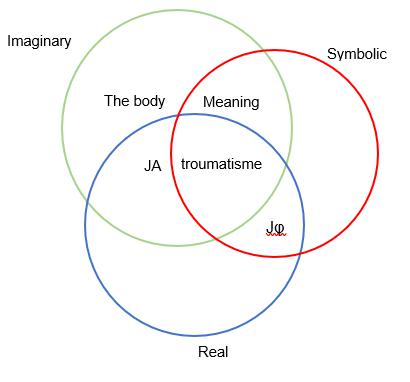
The term troumatisme is used by Lacan in lesson eight of Seminar XXI to describe trauma as a ‘hole’ in the Real.[9] The idea of a ‘hole in the Real’ is somewhat counterintuitive, perhaps, because the concept of a ‘hole’ implies the existence of a signifying network. However, as I understand it, the intersection of the three Borromean rings is a way to show how one register can create a rupture in another; in this case both the Symbolic and the Imaginary are creating a rupture in the Real. However, such a schema does not in itself throw much light on the drive as being neither ‘external’ nor ‘internal’; or, to put it another way, the idea of the drive as extimate.
The ‘extimacy’ of the drive
One way to illustrate the extimacy of the drive is to think about the relation between the drive and culture. At first sight these might seem to be diametrically opposed; after all, isn’t the drive something ‘internal’ to the subject, whereas culture is something ‘external’? And as Mladen Dolar points out in his paper on this topic, it is all too easy to read Freud this way, for example in Civilisation and its Discontents.[10] Dolar, however, argues that culture and the drive are intertwined in six different ways (which he describes as the ‘six fundamental traits of the drive’), and these are (i) as the mastery of nature, (ii) as the non-functional supplement (the inverse of (i)); (iii) the drive towards cleanliness, which Dolar links to the anal drive); (iv) the drive towards order, which Dolar links to the compulsion to repeat; (v) spiritual elevation, which he links to sublimation; (vi) the renunciation of satisfaction, which as Dolar notes, following Lacan, is precisely the drive’s means of satisfaction. In terms of my own argument, there a number of overlaps with Dolar’s. For example, the drive’s continuous repetition, which, paradoxically becomes its mode of satisfaction; and the idea of the ‘supplementary’ nature of the drive’s object. Dolar’s argument here is that one way to view culture is precisely in terms of its non-utility, its ‘uselessness’: “The moment of expenditure, of the non-functional, of waste, which defies the logic of self-preservation and survival, is the true breeding ground of culture.”[11] There seem to be strong echoes here of the idea of a surplus (supplementary) enjoyment (jouissance), which appears to undermine a strictly utilitarian concept of culture, that is, one that functions to ensure human survival. With regards to this apparent dichotomy between the utilitarian and the ‘non-functional Dolar comments:
The two first traits form a paradoxical couple: on the one hand, culture as the maximization of utility, and on the other hand, culture as uselessness, pure expenditure. Is culture something that serves best or something that doesn’t serve at all? Utility or futility? The maximum purpose or no purpose at all? But purpose for what, in view of what?[12]
In many ways this seems to be another way of describing the (apparent) dichotomy between the pleasure principle and its ‘beyond’ (the Other jouissance). This is also, perhaps, a way to read Freud’s Civilisation and its Discontents.[13] Freud’s basic argument here was the price of civilisation (and it is important to note that the German title of the work is Das Unbehagen in der Kultur) is the renunciation of the (direct) satisfaction of the drives. In other words, ensuring that the pleasure principle fulfils its function. But as Lacan realised, the idea of a ‘direct’ satisfaction of the drive was something of a misnomer; rather, the drive’s ‘satisfaction’ lay precisely in its eternal repetition, its ‘non-satisfaction’. In this reading, ‘civilisation’ (Kultur) becomes the site for the enactment of the (death) drive rather than the renunciation of it.
However, one problem that Dolar does not address is the precise relationship between the ‘external’ and the ‘internal’; in other words, how the ‘internal’ drive acts on the ‘external’ culture. And this is where Lacan’s concept of extimacy is crucial, and where the Borromean schema I referred to earlier is especially useful, because it effectively circumvents the whole dichotomy of ‘internal-external’. Furthermore, such a schema allows us to avoid having to talk about the ‘external world’ as being the site of trauma, and, conversely, the construction of trauma as taking place ‘within’ the psychical apparatus (through the operation of drive-jouissance).
The drive and surplus jouissance
But what of the jouissance in ‘drive-jouissance’? In Seminar XVII Lacan argues that knowledge “…is dominated, articulated by purely formal necessities, the necessities of writing, and in our day this leads to a certain type of logic.”[14] This ‘certain type of logic’, Lacan explains, is modern logic and although it might be regarded as the most ‘purified’ form of knowledge, it is the same knowledge that appears, in the guise of repetition, in the analyst’s consulting room.
Furthermore, according to Lacan:
This knowledge here reveals it roots in the fact that in repetition, and in the form of the unary trait to begin with, it is found to be the means of jouissance – precisely insofar as jouissance goes beyond the limits imposed, under the term of pleasure, on the usual tensions of life.[15]
The essence of Lacan’s argument here is that the signifier is an apparatus of jouissance. However, there is a further key part of Lacan’s argument, and this is that in its endless repetition, jouissance is running down, disappearing, which he refers to as its entropy. At the same time, though, something appears in place of this ‘disappeared’ or ‘lost’ jouissance, the object a:
What becomes evident…is, as we were saying just before, that there is a loss of jouissance. And it is in the place of this loss introduced by repetition that we see the function of the lost object emerge, of what I am calling the a. What does this impose on us? If not this formula that at the most elementary level, that of the imposition of the unary trait, knowledge at work produces, let’s say, an entropy.[16]
This ‘lost object’, the object a, is a ‘stand-in’ for the ‘actual jouissance’ of the subject, and in the same seminar is described by Lacan as surplus jouissance. However, in developing his concept of surplus jouissance Lacan also discounts his previous argument (in Seminar VII) that jouissance is a transgression, something forbidden; on the contrary, argues Lacan:
We are not dealing with a transgression, an irruption into some forbidden field through the wearing away of vital regulatory apparatuses (the pleasure principle). In fact, it is only through this effect of entropy, through this wasting, that jouissance acquires a status and shows itself. This is why I initially introduced it by the term “Mehrlust,” surplus jouissance…Only the dimension of entropy gives body to the fact that there is surplus jouissance there to be recovered.[17]
In other words, surplus jouissance is an effect of the repetition of the signifier; a repetition that is ‘powered’ by the circuit of the drive. According to Jacques-Alain Miller, such surplus jouissance can be regarded as a supplement to the loss of jouissance and as extending the register of the object a beyond ‘natural’ objects and encompassing those of industry and culture. These are the ‘crumbs’ of jouissance – ‘minor objet petit a‘: “We see our cultural world inhabited by substitutes for jouissance, which are little nothings. These are crumbs of jouissance which give a particular style to our way of life and our way of enjoying.”[18] What Miller is getting at here is that although previously Lacan (following Freud) was arguing that the objects of the drive were all ‘natural’, that is, the erogenous zones of the body, and therefore the object a was related to the ‘lost’ jouissance associated with each of these zones, with the advent of the concept of surplus jouissance this effectively generalises the idea of jouissance; in other words, anything, any object in world, can be the source of the ‘lost’ jouissance.
The concept of ‘drive-scraping’
There is one more question that arises in relation to drive-jouissance: how does surplus jouissance get to traumatise the subject? In other words, even if Miller is right and the subject gains (‘crumbs’ of) enjoyment from objects in the cultural world, what is the ‘mechanism’ (for want of a better term) that leads to the subject becoming overwhelmed, that is, traumatised, by such enjoyment? My contention is that such a mechanism can be described as drive-scraping, which is a term I have borrowed from the world of computing and the concept of web scraping. Put very briefly, this is the automated process of extracting data from websites. It involves using software or scripts to access web pages, parse their content (typically HTML), and retrieve specific information such as text, images, or links. Businesses, researchers, and developers use web scraping to gather data for market analysis, academic studies, price monitoring, and so on.[19]
The crux of my argument is that just as robots ‘scrape’ the web for ever more data, so does the drive ‘scrape’ the cultural landscape for ever more surplus jouissance. And it is worth noting, of course, that the Internet and the World Wide Web are very much part of this cultural landscape and provide the source of a great deal of Miller’s ‘crumbs of jouissance’. Furthermore, the analogy between drive and web scraping may be even more apt when we remember that in Seminar II Lacan’s argument regarding the mechanism of language and its relation to the drive drew heavily upon his interest in cybernetics which provides the foundations for modern computing and artificial intelligence (AI). This is something John Johnston discusses in some depth in his study of cybernetics, AI and artificial life.[20]
Implications for war trauma
What, though, has this to do with the overall topic of this essay, that is, the trauma of war? First of all, it is important to note that war has its own ‘cultural landscape’; and if we think of the current conflict in Ukraine, such a landscape extends from the trenches on the front line to the UAV (drone) ground control stations which may be hundreds (or even thousands) of miles away. In fact, bearing in mind that the war is being constantly beamed around the globe via mainstream and social media, one might argue that its cultural landscape is now also global.
Furthermore, it is also important to remember that the idea that a particular war or conflict has an ever-broadening cultural landscapes is nothing new. Think, for example, of the whole ‘Holocaust industry’ that grew out of the Shoah; or the seemingly insatiable appetite for First and Second World War ‘history’. And, approaching this from a slightly different angle, works such as Paul Fussell’s The Great War and modern memory are a reminder that not only do wars and conflicts become continually ‘reimagined’ by successive generations, but even at the time (in this case, the Great War of 1914-1918) a continuous cultural (re)construction is taking place. For example, Fussell notes that the ideas of the English pastoral and the influence of Georgian poetry were critical in shaping how contemporary war poets, writers and artists thought about and represented the war on the Western Front; both at the time and in the years following the Armistice of 1918. Such representations were then conveyed to the public on the ‘home front’ in the form of poems, books, films, photographs, paintings, newspaper articles, and so on. In other words, even whilst the Great War was going on there was a continual ‘scraping’ of the cultural landscape of war for surplus jouissance, and this only intensified in the years and decades following. And by the time we get to the Vietnam War in the 1960s, its cultural landscape had become truly global with images of the war being beamed every night into people’s living rooms all round the world.
At this point it could be argued that what I’m actually describing is so-called ‘vicarious trauma’, that is, trauma experienced by those not physically present at the site of the (traumatic) event. And such ‘traumas’ were already been recognised both during and in the aftermath of the Vietnam War when it was realised that a number of people who were developing the symptoms of PTSD (Freud’s war neurosis) had never been anywhere near a combat zone. But the crux of my argument is that although those who are physically present at the site of the event (for example, soldiers on the front line) are clearly going to be far more exposed to (and potentially overwhelmed by) its intensity, the trauma itself lies not in the event but in the jouissance of the drive. This means that even for those individuals who may be watching the war unfold from the ‘comfort’ of their living room on TV or on social media, such drive-jouissance can still become unbearable. Or, to put it another way, even those who are physically present at the site of the event still have to ‘subjectify’ it in the form of representations. And such ‘subjectification’ and representation, I argue, is the work of the drive.
Notes and References
- https://eprints.kingston.ac.uk/id/eprint/55990/ ↑
- Leslie Chapman, Traumatic Neurosis Revisited: drive jouissance and the wounds of life (London, Palgrave, 2025), forthcoming. ↑
- Sigmund Freud, “Beyond the Pleasure Principle,” in The Standard Edition of the Complete Psychological Works of Sigmund Freud, vol. XVIII (London: Hogarth Press, 1920), 3–64. ↑
- Sigmund Freud, “Inhibitions, Symptoms and Anxiety,” in The Standard Edition of the Complete Psychological Works of Sigmund Freud, vol. XX (London: Hogarth Press, 1926), 77–175. ↑
- I use ‘drive’ in the singular following Lacan’s proposition that there is only one drive, namely, the death drive. ↑
- Jean-Louis Gault, ‘Two Statuses of the Symptom: “Let Us Turn to Finn Again”’, in The Later Lacan: An Introduction, ed. by Véronique Voruz and Bogdan Wolf (State of New York: Sunny Press, 2007), 73–82. ↑
- Jacques-Alain Miller, “Is Feminine Jouissance Not Jouissance as Such?,” Lacanian Lnk, no. 55/56 (2021): 34–51. ↑
- Gault, ‘Two Statuses of the Symptom’, 80. ↑
- “But we all know, because all of us invent something to fill up the hole in the Real. Where there is no sexual relationship this gives a ‘troumatisme’” (Jacques Lacan, The Seminar of Jacques Lacan : Book XXI : Les Non Dupres Errent: 1973-1974, trans. by Cormac Gallagher (Dublin: Unpublished translation by Cormac Gallagher, 2010), 151. (Hereafter Seminar XXI) ↑
- Mladen Dolar, ‘Of Drives and Culture’, in Analyzing the Cultural Unconscious: Science of the Signifier, ed. by Henrik Bjerre and others (London: Bloomsbury Academic, 2020), 69–86. ↑
- Ibid., 74. ↑
- Ibid., 75. ↑
- Sigmund Freud, “Civilisation and Its Discontents,” in The Standard Edition of the Complete Psychological Works of Sigmund Freud, vol. XXI (London: Hogarth Press, 1930), 59–145. ↑
- Jacques Lacan, The Other Side of Psychoanalysis: The Seminar of Jacques Lacan Book XVII, trans. Russell Grigg (New York: W.W Norton and Co., 2007), 48. ↑
- Ibid., 48. ↑
- Ibid., 48. ↑
- Ibid., 50. ↑
- Jacques-Alain Miller, “Six Paradigms of Jouissance,” Psychoanalytical Notebooks, no. 34 (December 2019), 61. ↑
- For a (reasonably) academic introduction to this process see: Nicholas J DeVito, Georgia C Richards, and Peter Inglesby, ‘How We Learnt to Stop Worrying and Love Web Scraping.’, Nature, 585.7826 (2020), 621–22. And for the Wikipedia entry for this topic see: “Web Scraping,” in Wikipedia, February 22, 2025, https://en.wikipedia.org/w/index.php?title=Web_scraping&oldid=1277016561. ↑
- John Johnston, The Allure of Machinic Life: Cybernetics, Artificial Life and the New AI (Cambridge, Massachusetts: MIT Press, 2008). ↑
Exploring the ‘wounds of life’ requires moving beyond the literal event to the structural truth of the drive. To see how this analysis fits into a wider clinical framework, please visit the Empire of Trauma Hub.
Last updated: March 31, 2026
While psychoanalytic theory conceptualises trauma, repetition, and the limits of the signifier, clinical work takes place in the singular encounter with one’s own symptom. If you are seeking a space to speak that lies outside directive or manualised therapies, I can offer psychoanalytic consultations online via Therapeia. Please click here for further details.