
I’m delighted to announce the publication of my book on psychoanalysis and AI, which can be found on all the main Amazon platforms in both print and Kindle editions! In Teleoplexic Hubris I confront this computational ideal through an encounter between late Lacanian psychoanalysis and the materialist critiques of contemporary accelerationism. Reading Jacques Lacan’s register of the Real against the feedback loops of cybernetic capital, this text interrogates the limits of automated affect and outlines a clinic anchored in the stubborn unassimilability of the chthonic substrate.
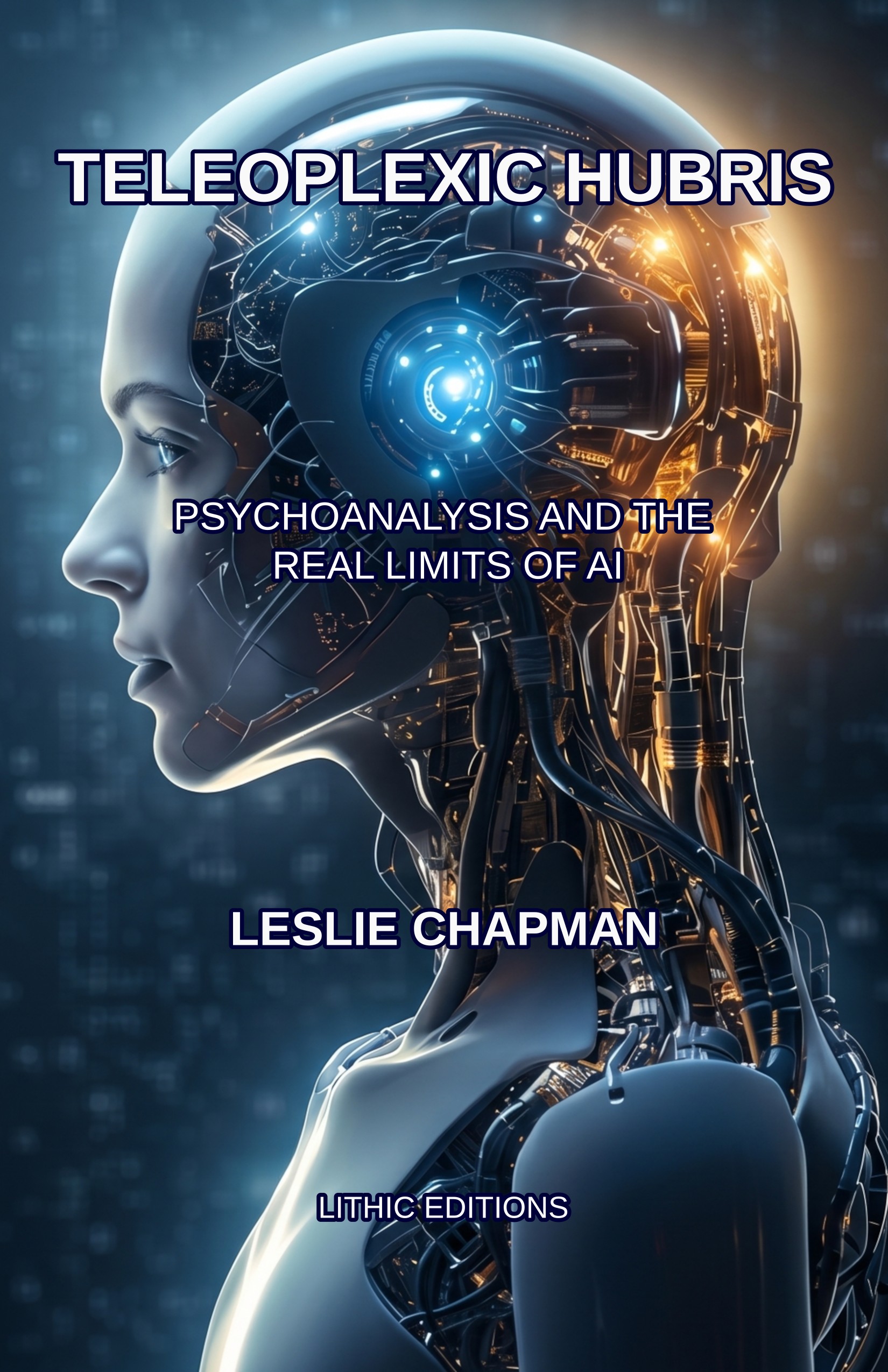
“What, then, is the enduring task of psychoanalysis in an age dominated by the algorithmic capture of the social bond? In my view, the psychoanalytic (and specifically Lacanian) orientation cannot preserve its relevance by attempting to halt technological evolution or seeking shelter behind professional monopolies. Nor can it survive by subordinating its practice to the predictive, data-driven demands of institutional efficiency. Instead, the ethical imperative of psychoanalysis is to stand as the guardian of the Not-All.”
As generative artificial intelligence transforms digital culture, therapeutic discourse increasingly yields to automated symptom management. Positioned as both an epistemic poison and its synthetic cure, the algorithmic apparatus operates as a hyper-pharmakon, saturating the social field with homeostatic, predictive meaning while reducing the unconscious to informational noise.