
In the concluding part of Studies on Hysteria Freud writes:
When I have promised my patients help or improvement by means of a cathartic treatment I have often been faced by this objection: ‘Why, you tell me yourself that my illness is probably connected with my circumstances and the events of my life. You cannot alter these in any way. How do you propose to help me, then?’ And I have been able to make this reply: ‘No doubt fate would find it easier than I do to relieve you of your illness. But you will be able to convince yourself that much will be gained if we succeed in transforming your hysterical misery into common unhappiness. With a mental life that has been restored to health you will be better armed against that unhappiness.’[1]
In an age dominated by the search for happiness and fulfilment, Freud’s assessment of the ‘therapeutic’ value of psychoanalysis seems unlikely to attract many takers. This may be one of the reasons why psychoanalysis, at least in its original form, is something of a rarity in mainstream ‘mental health’ services; in fact, it is pretty much non-existent. Those who wish to engage with something resembling the Freudian experience will not find it on the NHS or its equivalent in other countries; rather, they will have to seek it out in the private sector, and even then I would argue that they would be hard pressed to find it. But this then begs the question: why would anyone invest hundreds, or, more likely, thousands, of pounds in a ‘therapy’ that is not a therapy? In other words, why pay all that money just to end up feeling miserable – even if, as Freud argues, they will at least be able to better cope with such misery?
Perhaps one answer to this question is that there are worse things in life than feeling miserable. One of these could be happiness itself, of course. This appears to have been Lacan’s view, when, for example, he comments in Television on the idea of the ‘happy subject’: “What is astonishing is not that he is happy without suspecting what reduces him to this state — his dependence on the structure —but that he gets an idea of beatitude, an idea which is forceful enough for him to feel himself exiled from it.” [2] However, it might be more fruitful here to think about what the aim of analysis actually is, and why it is not particularly helpful to conflate it with the idea of ‘therapy’.[3]
In his paper Two Statues of the Symptom, Jean-Louise Gault argues that in the psychoanalysis of neurotic subjects there is a movement from the Symbolic to the Real:
An analysis, in the case of neurosis, begins when a patient meets a psychoanalyst to complain of a symptom, and the analysis consists in the deciphering of this symptom. At the end, an analysis claims to go beyond the fantasy that supported the symptom, in order to reach the real of the drive that is lodged at the heart of the jouissance of the symptom. Thus, the analysis of a neurotic subject goes from the symbolic constituted by the formal envelope of the symptom, to the real of the drive.[4]
And Jacques-Alain Miller refers to “…bringing the subject back to his truly elementary signifiers, on which he has, in his neurosis, had a delusion.” [5] The emphasis for both Gault and Miller is on a movement away from fantasy, away from delusion, towards the Real. However, this immediately begs the question: for what purpose? Although neither Gault or Miller explicitly state it, such a movement is unlikely to bring the subject ‘happiness’ or ‘fulfilment’. On the other hand, it may well bring the subject closer to a truth about their existence. The problem for the neurotic subject, I would argue, is that they have already glimpsed such a truth and have decided they will have nothing more of it. Instead they construct a story (or, as Miller likes to put it, a hystory[6]) that circumvents (and circumscribes) this truth.
Somewhat paradoxically, perhaps, this story usually concerns, in some form or another, the very truth the subject is trying to evade. In broad terms, the story is concerned with the trauma of the subject’s life, which is ultimately about the subject’s relationship with the Real. However, by ‘historising’ such a relationship, by constructing what is essentially a trauma narrative about the subject’s encounter with the Real, the subject aims to ‘detraumatise’ such an experience by giving it meaning.
And the question of meaning brings us back to the question of why psychoanalysis is not psychotherapy. At this point it is probably worth reflecting on the fact that the term ‘psychotherapy’ is often rendered as ‘soul healing’ (from the Greek psyche = soul and therapeia = healing). I would argue that for both theologians and die-hard materialists the idea of the psyche as equating with the ‘soul’ is highly problematic, but putting that to one side for a moment the general idea of psychotherapy appears to be one of healing the subject. But how does such healing operate in this case? Through words, and, more specifically, through the construction of meaning.
In his paper Pure Psychoanalysis, Applied Psychoanalysis, and Psychotherapy, Miller argues that psychoanalysis rejects meaning, whereas psychotherapy embraces it.[7] In what is in fact a very complex argument, Miller shows how in his later work Lacan moved away from the need of psychoanalysis to look for an ‘anchoring point’ in order to establish meaning and instead developed the idea of the Borromean Knot to circumvent such a need :
The circles of string which compose the Knot pull, snag, limit each other, but they always leave degrees of freedom in their individual relationship…the Knot they form does not lend itself to a crossing of vectors from which the illumination of the anchoring point can proceed…The anchoring point is a phenomenon of meaning, which is precisely what one should renounce where the outside-meaning should dominate the affair.[8]
By ‘outside-meaning’ Miller is referring to the Real, which is the proper concern of psychoanalysis. The reference to the Borromean Knot is crucial here because this is a radically different way to ‘map-out’ the subject in relation to the three registers (Real, Symbolic, Imaginary):
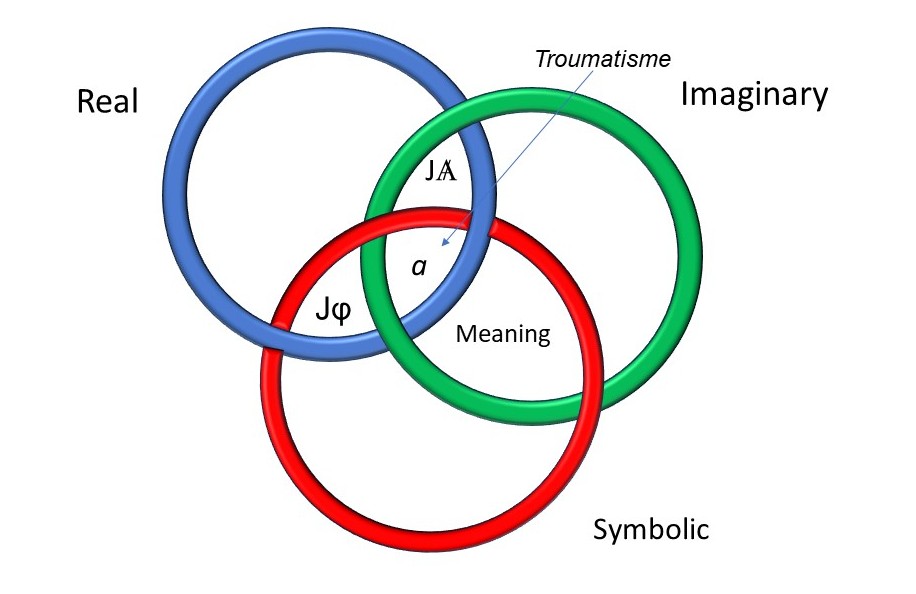 I will be coming back to this schema in subsequent posts but the key thing to note at the moment are the intersections of the three ‘rings’, which represent the three registers. For example, the jouissance of the Other (JȺ) is situated at the intersection of the Real and the Imaginary, whereas phallic jouissance (Jφ) is at the intersection of the Real and the Symbolic. Meaning, on the other hand, is situated at the intersection of the Imaginary and the Symbolic. And perhaps most significantly of all, the object a is situated at the intersection of all three registers. In some discussions of the schema Lacan refers to the object a as surplus jouissance and also as a troumatisme, which is a neologism that Lacan uses to convey the idea of a ‘hole’ in the Real, which is also his way to define trauma.[9] The idea of a ‘hole in the Real’ is somewhat counterintuitive, perhaps, because the concept of a ‘hole’ implies the existence of a signifying network. However, as I understand it, the intersection of the three Borromean rings is a way to show how one register can create a rupture in another; in this case both the Symbolic and the Imaginary are creating a rupture in the Real.
The key point here is that this troumatisme is also the place of the subject and, as the schema clearly shows, the site of the subject is the site of trauma, not meaning. Whether such a realisation, such a truth, is something the subject can bear is another matter, but perhaps the best psychoanalysis can do is to bring the subject to the point where they are in a position to make this decision.
Notes and references
- Sigmund Freud and Josef Breuer, ‘Studies on Hysteria’, in The Standard Edition of the Complete Psychological Works of Sigmund Freud (London: Hogarth Press, 1895), II, p.305. ↑
- Jacques Lacan, Television: A Challenge to the Psychoanalytic Establishment, trans. by Jeffrey Mehlman (New York: WW Norton & Co, 1990), pp.23-24. ↑
- This is in spite of the fact that the quotation from Freud at the beginning of this post is from the section entitled ‘Psychotherapy of Hysteria’. ↑
- Jean-Louis Gault, ‘Two Statuses of the Symptom: “Let Us Turn to Finn Again”’, in The Later Lacan: An Introduction, ed. by Véronique Voruz and Bogdan Wolf (State of New York: Sunny Press, 2007), p.75. ↑
- Jacques-Alain Miller, ‘Interpretation in Reverse’, in The Later Lacan: An Introduction, ed. by Véronique Voruz and Bogdan Wolf (State of New York: Sunny Press, 2007), p.7. ↑
- Jacques-Alain Miller, ‘The Space of a Hallucination’, The Lacanian Review 6, 6, 2018, 82–107. ↑
- Jacques-Alain Miller, ‘Pure Psychoanalysis, Applied Psychoanalysis, and Psychotherapy’, English Literature, 2011 <http://literarism.blogspot.com/2011/12/pure-psychoanalysis-applied.html> [accessed 24 February 2024]. Originally published in Lacan Ink 20, May 2002. ↑
- Ibid., p.9. ↑
- “But we all know, because all of us invent something to fill up the hole in the Real. Where there is no sexual relationship this gives a ‘troumatisme’” (Jacques Lacan, The Seminar of Jacques Lacan : Book XXI : Les Non Dupres Errent: 1973-1974, trans. by Cormac Gallagher (Dublin: Unpublished translation by Cormac Gallagher, 2010), 151. ↑
Last updated: June 25, 2025
While psychoanalytic theory conceptualises trauma, repetition, and the limits of the signifier, clinical work takes place in the singular encounter with one’s own symptom. If you are seeking a space to speak that lies outside directive or manualised therapies, I can offer psychoanalytic consultations online via Therapeia. Please click here for further details.