
In a number of articles I have explored Freud’s concept of Nachträglichkeit and its relation to trauma. As I have pointed out in these texts Freud’s basic argument, which has been taken up by a number of other analysts (notably Laplanche), was that although a subject may experience an event, for example in their early childhood, which most people (nowadays at least) would regard as traumatic, for example, sexual abuse, at the time the individual does not experience it as such. Rather, it is only years (and sometimes decades) later, when another event occurs which in some way resonates with the earlier one, that they become traumatised. And the critical point here is that this is not some kind of ‘delayed trauma’ or that the second event somehow ‘reminds’ the subject of the first (traumatic) one; rather the trauma is only constructed at the time of the second event.
A well-known and very early example given by Freud is that of Emma:
Emma is subject at the present time to a compulsion of not being able to go into shops alone. As a reason for this, [she produced] a memory from the time when she was twelve years old (shortly after puberty). She went into a shop to buy something, saw the two shop-assistants (one of whom she can remember) laughing together, and ran away in some kind of affect of fright. In connection with this, she was led to recall that the two of them at her clothes and that one of them had pleased her sexually.[1]
She then associated this incident with another memory when she was eight when she went into a shop to buy some sweets and the shopkeeper grabbed her genitals through her clothes. In spite of this experience, she went back a second time but stayed away thereafter. Freud argued that the laughter of the shop assistants provided the associative link with the original incident, which reminded her of the grin of the shop keeper as he assaulted her:
The course of events can now be reconstructed as follows. In the shop the two assistants were laughing; this laughing aroused (unconsciously) the memory of the shopkeeper. Indeed, the situation had yet another similarity [to the earlier one]: she was once again in a shop alone. Together with the shopkeeper she remembered his grabbing through her clothes; but since then she had reached puberty. The memory aroused what it was certainly not able to at the time, a sexual release, which was transformed into anxiety. With this anxiety, she was afraid that the shop-assistants might repeat the assault, and she ran away.[2]
The essence of Freud’s argument is that the release of sexual excitation, which was transformed into anxiety, is what led Emma to flee from the laughing shop assistants. One reading of this, for example that of Bistoen et al, is that this was the result a false association on the part of Emma, that is, she attributed her anxiety (the result of sexual excitation) to one of the shop assistants, whereas in fact it was rooted in the earlier assault by the shopkeeper.[3] As Freud explains:
If we ask ourselves what may be the cause of this …pathological process, only one presents itself – the sexual release, of which there is also evidence in consciousness. This is linked to the memory of the assault; but it is highly noteworthy that it [the sexual release] was not linked to the assault when this was experienced. Here we have the case of a memory arousing an affect which it did not arouse as an experience, because in the meantime the change [brought about] in puberty had made possible a different understanding of what was remembered.[4]
At this point Freud makes a critical assertion: “We invariably find that a memory is repressed which only become a trauma by deferred action.”[5] The term ‘deferred action’ (nachträglich) is the result of a mistranslation by Strachey. It is problematic because it implies the idea a ‘delayed trauma’, which is precisely what Nachträglichkeit does not mean. In the article I cited earlier, Bistoen et al provide a useful schema to illustrate the logic of Nachträglichkeit:
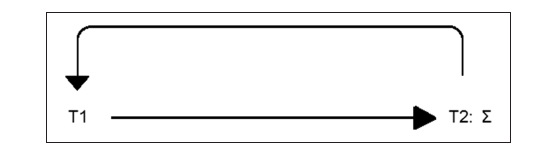
The logic of Nachträglichkeit [6]
In this schema T1 represents the moment in time of the ‘original’ event or ‘scene’ (in this case Emma’s assault by the shop keeper), whilst T2 represents the moment of the second scene (the incident with the two shop assistants) which is designated by Σ:
Freud’s capital discovery here is that the pathological power of the second scene at T2 is derived from an earlier experience at T1. However, this first event remained without consequence for many years, indicating that it did not become “traumatic” until after its revival at T2. Freud emphasized that it was the memory that became traumatic, whereas the experience originally was not, and it did so precisely at the moment of T2. Nachträglichkeit thus refers to a mechanism that literally alters the subjective interpretation of the past, in such a way that this altered memory causes new and unexpected effects in the present.[7]
Bistoen et al also note that the ‘sexual release’ (experienced by Emma as anxiety) was falsely attributed (by her) to the shop assistant that she found sexually attractive whereas its true origin lay in the actions of the shopkeeper four years previously. In other words, and this is the truly strange characteristic of Nachträglichkeit, an event in the subject’s present creates an associative chain back to an event in the past, but the trauma (of that event) is experienced in the here-and-now – and wrongly associated with the present event. Furthermore, Bistoen et al argue that the reason that such an associative chain can be constructed in the first place is that the ‘original’ event leaves a memory (mnemic) trace: “…something that simultaneously points to and obscures the original mystifying scene.”[8] One candidate for such a trace is the shopkeeper’s grin as he assaulted her. This also highlights another important characteristic of Nachträglichkeit: there has to be some similarity or association between the first and the second event. In Emma’s case the association was that of laughter.[9]
Just to reiterate: in this interpretation of Nachträglichkeit the ‘real’ trauma, although constructed in the present, concerns an event (scene) in the past. In this sense it could be still be argued that there is an ‘original’ trauma, even though it is retroactively constructed. In other words, something did happen to the subject in their earlier life, even though they did not register it at the time as traumatic.
In my view, though, I think there are a number of problems with this reading of Nachträglichkeit. The first thing to point out is that, with regards to Emma, Freud did not use the term ‘trauma’ in his description of the case. Rather, he referred to the sexual release (which manifested itself as anxiety) that led Emma to run out of the shop at age twelve. This prefigures an idea that will appear in Beyond the Pleasure Principle over twenty years later where Freud argues that trauma is caused by excessive excitation.[10] However, it is not until Inhibitions, Symptoms and Anxiety that the source of such excitation becomes clearer.[11] In Beyond the Pleasure Principle Freud appears to be arguing that the source of such excitation (which he will define as trauma) is the external world which breaches the defences of the psychical apparatus. But in his later text he places more emphasis on the drive in the production of the excitation. And in Lacanian terms this can be formulated as the jouissance of the drive or drive-jouissance.[12] The key point here in relation to the Emma case is that drive-jouissance (Freud’s ‘sexual release’) is traumatic in its own right. However, the crux of the matter is that Emma did not (necessarily) make a ‘false association’ with regards to the excitation (jouissance) of the drive after all. Freud’s argument is that it is only once Emma had reached puberty that she was able to ‘understand’ the full significance of what had happened to her in the shop at age eight. This implies that the onset of puberty effected a transformation or reconfiguration of her subjectivity that led her to feel the force of the trauma of the assault by the shopkeeper. But such a reconfiguration is the work of Nachträglichkeit itself. In his letter (52) to Fliess, Freud writes:
As you know, I am working on the assumption that our psychic mechanism has come into being by a process of stratification: the material present in the form of memory-traces being subjected from time to time to a rearrangement in accordance with fresh circumstances – to a retranscription. Thus what is essentially new about my theory is the thesis that memory is present not once but several times over, that it is laid down in various kinds of indications. I postulated a similar kind of rearrangement some time ago (Aphasia) for the paths leading from the periphery [of the body to the cortex]. I do not know how many of these registrations there are: at least three, probably more.[13]
The key point here is that Nachträglichkeit gives a different meaning to past events. Referring back to the case of Emma, the incident with the two shop assistants at age twelve resulted in a retroactive ‘looping back’ to the earlier memory trace (from age eight) which in turn rewrote or retranscibed her history. And within this new ‘version’ of her history the incident with the shop keeper at age eight suddenly took on a new significance; or, to be more precise, it took on a significance that it had lacked before. Although this may seem to be simply restating Freud’s argument that I cited above and which was further clarified by Bistoen et al, I think there is subtle but crucial difference. The first interpretation (Bistoen et al’s) places the emphaisis on the event at T1, which is essentially ‘uncovered’ by the retroactive construction enabled by the event at T2; in other words, it’s the event and its traumatic nature at T1 which is crucial here, even though its traumatic effects are only felt at T2. My argument, however, is that the trauma does not ‘reside’ in the event at all; neither at T1 nor T2. In fact, it does not ‘reside’ in the memory, the associative chain, that is constructed through the process of Nachträglichkeit either. Rather, the trauma is the effect of the jouissance of the drive (drive-jouissance) which is produced by the drive’s ‘scraping’ of the memory in search of surplus jouissance.[14]
It is important to emphasise at this point that I am not denying for moment that something deeply troubling and disturbing happens to the subject at T1 (Emma’s assault by the shopkeeper for example). In fact, the reason that an associative chain can be constructed from T2 ‘back’ to T1 in the first place is because there is a ‘resonance’ between the events at these two different moments in time. However, it’s what happens at T2 that’s crucial: the associative chain, the memory, constructed between T1 and T2 is too much to bear for the subject and they become traumatised. But the critical point here is that what’s too much to bear is the excitation (jouissance) of the drive that such a memory produces, not the memory itself.
One of the problems with the concept of Nachträglichkeit is why the subject does not register the event at T1 as traumatic at the time; in fact, why, in many cases, they don’t appear to register the event at all. In the case of Emma, Freud notes that even after the first assault by the shopkeeper she went back into the shop second time only to be assaulted again. Freud’s argument was that it was only once she had reached puberty that the earlier event was given a meaning that it lacked before, but this still begs the question as to why it lacked such a meaning in the first place. It’s worth noting, of course, that at age eight Emma would have been right in the middle of what Freud would describe as the ‘latency stage’ where there is essentially a repression of the drive; it is only at puberty that the operation of the drive bursts forth with a vengeance. And if trauma can be formulated in terms of the jouissance of the drive then its hardly surprising that the encounter with the two shop assistants, one of whom Emma found desirable, should be so traumatic, that is, so sexually charged.
Notes and references
- Sigmund Freud, “Project for a Scientific Psychology,” in The Standard Edition Vol I, vol. I (London: Hogarth Press, 1950), 353, italics in original. ↑
- Ibid., 354. ↑
- Gregory Bistoen, Stijn Vanheule, and Stef Craps, “Nachträglichkeit: A Freudian Perspective on Delayed Traumatic Reactions,” Theory and Psychology, 2014, 1–20. ↑
- Freud, “Project”, 356, italics in original. ↑
- Ibid., 356, italics in original. ↑
- Bistoen et al, “Nachträglichkeit”, 7. ↑
- Ibid., 7, italics in original. ↑
- Ibid., 9. ↑
- There is also another association which is the signifier ‘clothing’. In the second scene, at age twelve, Emma thought the shop assistants were laughing at her clothes. In the first scene (with the shopkeeper at age eight) she remembered him grabbing her genitals through her clothes. ↑
- Sigmund Freud, “Beyond the Pleasure Principle,” in The Standard Edition of the Complete Psychological Works of Sigmund Freud, vol. XVIII (London: Hogarth Press, 1920), 3–64. ↑
- Sigmund Freud, “Inhibitions, Symptoms and Anxiety,” in The Standard Edition of the Complete Psychological Works of Sigmund Freud, vol. XX (London: Hogarth Press, 1926), 77–175. ↑
- I explore the concept of drive-jouissance and its relationship to trauma in my book Traumatic Neurosis: Drive Jouissance and the Wounds of Life, Palgrave, 2025. ↑
- Sigmund Freud, The Complete Letters of Sigmund Freud to Wilhelm Fliess 1887-1904, trans. Jeffrey M. Masson (Cambridge, Massachusetts: The Belkap Press of Harvard University Press, 1985), 207, italics in original. ↑
- This is an idea that I explain in detail in my book but essentially it draws upon Miller’s idea of the subject perpetually searching for ‘crumbs of jouissance’ in the cultural world (which is essentially the world of representation, including memories): Jacques-Alain Miller, “Six Paradigms of Jouissance,” Psychoanalytical Notebooks, no. 34 (December 2019): 11–77. ↑
Exploring the ‘wounds of life’ requires moving beyond the literal event to the structural truth of the drive. To see how this analysis fits into a wider clinical framework, please visit the Empire of Trauma Hub.
Last updated: November 5, 2026
While psychoanalytic theory conceptualises trauma, repetition, and the limits of the signifier, clinical work takes place in the singular encounter with one’s own symptom. If you are seeking a space to speak that lies outside directive or manualised therapies, I can offer psychoanalytic consultations online via Therapeia. Please click here for further details.