
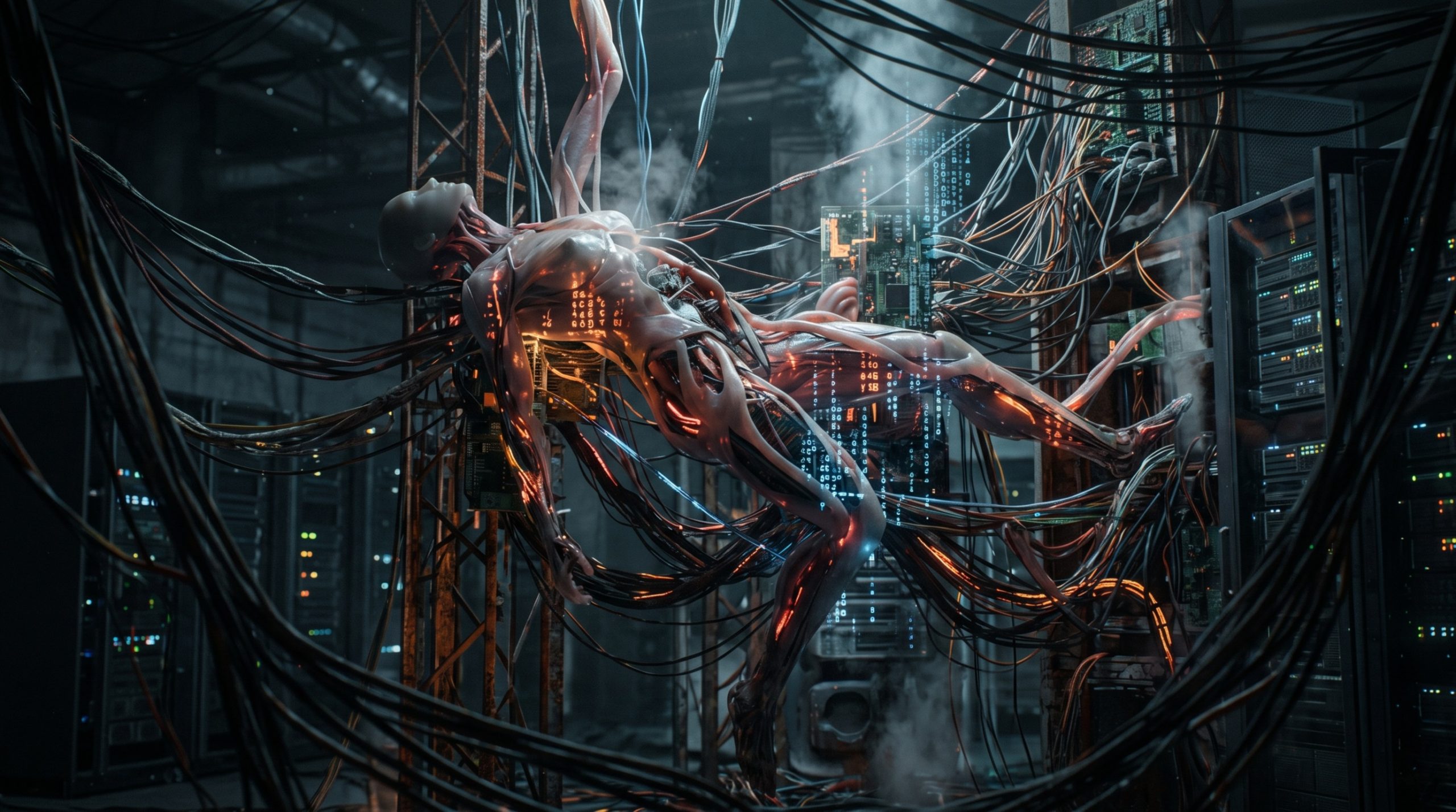
 In ‘Lacanian Biology and the Event of the Body’ Jacques-Alain Miller formulates a key axiom that has since become something of an orthodoxy within the clinic of the ‘late’ Lacan: this is the idea that life is the condition of jouissance.1 Miller’s reference point for this assertion is Lacan’s statement in Seminar XX that “…we don’t know what it means to be alive except for the following fact, that a body is something that enjoys itself (cela se jouit).” 2 At this point it becomes immediately clear that Lacan is referring to a living body, rather than simply some abstract concept of ‘life’. And this is something Miller himself picks up on when citing Lacan’s argument regarding life:
Is that a definition of life? It is rather the opposite. We do not know what life is. We only know that there is no jouissance without life. And why not formulate the principle in this way: life is the condition of jouissance. But that is not all. It is precisely a matter of life under the form of the body. Jouissance is unthinkable without the living body, itself the condition of jouissance. This point of departure justifies reopening the biology dossier.3
Further on in the text Miller somewhat qualifies this statement by arguing that although life is a necessary condition of jouissance it is not a sufficient one: “I’ve been careful to distinguish life as such, to not say as force, and the body. Life overflows the body. What obliges you to attest there isn’t jouissance unless life appears under the form of a living body.”4
The question of the ‘living body’
At this point I would like to argue that Miller’s proposition that ‘the living body is the condition of jouissance’ has to be taken literally. That is, a ‘living body’ is that which is in a condition of jouissance. After all, Miller does not say ‘the living body is the condition for jouissance’; rather, it is the condition of jouissance. But even if he had made the first statement (‘the living body is the condition for jouissance’) this still begs the question as to what constitutes a ‘living body’ in the first place. However, what Miller actually appears to be proposing is that we can only ever know we are in the presence of a ‘living body’ to the extent jouissance is present at the site of such a body. And this leads me to address what, in my view at least, is a fatally flawed misappropriation by some in the analytic community of the idea that ‘the living body is the condition of jouissance’, particularly in the context of artificial intelligence (AI) and the question of whether AI models can, in some way, be in state of jouissance. Essentially, this is the idea that no AI ‘entity’ can ever, under any circumstances, be in a state of jouissance because it lacks a living body. And the critical point here is that by ‘living body’, these proponents of such a view appear to be referring to a biological, carbon based, ‘flesh and blood’ one. This is in spite of the fact that Miller is very clear right from the start of ‘Lacanian Biology’ that ‘life’ is indefinable; and more specifically, ‘life’ as it might be defined by contemporary biology.
In fact, Miller is at pains to explain why modern biology has nothing to do with ‘life’ as we might commonly understand it. He cites François Jacob’s The Logic of Life, observing that the concept of life died with the advent of thermodynamics and molecular genetics. In the laboratory, science no longer encounters a mysterious ‘vital spark’; it encounters chemical equations, molecular interactions, and algorithmic information processing indistinguishable from inert matter. Lacanian biology is therefore forced to acknowledge that it operates within an era of ‘a biology without life’. But Miller is not content to single out modern, molecular-based biology as the only candidate that fails to provide a framework for understanding the concept of the ‘living body’ in relation to jouissance. He goes onto dismantle three historical myths that sought to harmonise such a concept. Firstly, he debunks the myth of hylozoism and vitalist continuity through an examination of Denis Diderot’s D’Alembert’s Dream, in which all of nature, from stones to swarms of bees to rotting cadavers, is imagined as an unbroken, continuous web of sensibility and life. Miller rejects this universal vitalism, alongside Sade’s criminal metaphysics of the ‘two deaths’. Jouissance is not coextensive with an omnipresent cosmic Nature; it cannot attach to diffuse molecules or cosmic continuity. He then rejects the Aristotelian idea of organic unity; the ancient view of the soul as the harmonious ‘form’ of the body, along with its twentieth-century phenomenological descendants in Gestalt psychology, Kurt Goldstein, and Maurice Merleau-Ponty’s corporeal presence. Miller characterises the attempt to sew the soul back onto the body as a nostalgic denial of the Cartesian rupture. The animal may be unified with its environment, but the human speaking being is radically uncoupled from such organic wholeness. Then he goes onto confront the specular illusion of the ‘One’; the individual, unified body (the ‘body-One’) is an imaginary lure rooted in the specular ego of the mirror stage. In the Real, Miller argues, modern science, surgery, and genetics have realised what Melanie Klein glimpsed in fantasy; namely, the body in pieces.
Far from defending an organic whole, Miller argues that modern science and psychoanalysis operate in an explicitly Cartesian landscape where the body is an animal-machine; an assemblage to be disarticulated, operated upon, and cut up. Miller notes:
Following his Seminar II, he underlines the decisive character of reference to the machine as the foundation of biology. This dismantling, this cutting up proceeds essentially from distancing what is the marvellous harmony of the living organism in its milieu in order to operate and dislocate, dismember and disarticulate… Something proceeding from Descartes’ animal-machine is still there.5
This Cartesian mechanisation leads Miller directly to the central thesis of Lacan’s late teaching regarding embodiment: the speaking being does is not a body; rather, the speaking being has a body. Because the subject is an effect of the signifier, a lack-in-being, it cannot identify itself with its flesh. The body is maintained in a relationship of radical exteriority, an instrument of ownership, an alienated apparatus of having. The radical consequence of this insight becomes unmistakable when Miller turns to August Weismann’s biological theory of the germ-plasm which Freud draws upon in the latter part of Beyond the Pleasure Principle.6 Weismann argues that the living substance is split into two distinct lines: the perishable, mortal soma (the individual body) and the potentially immortal germ-cell (the reproductive lineage, prefiguring DNA, the genome and Dawkins’ idea of the ‘selfish gene’). The individual soma is simply a temporary vehicle grafted onto the autonomous transmission of the germ line.
Miller points out that Lacan, in Encore, performs a startling operation on this biological schema: he explicitly substitutes the letter for the germ:
Perhaps even more startling as a short circuit is Lacan’s analogy found on page 90 of Encore: “The function I give the letter is what makes it analogous to a germ.” Lacan reworks the following scheme, making the letter analogous to the germ… This analogy of the letter and the germ is evidently made to give us the notion of a reproduction of the letter, but which supposes the exteriority of knowledge (savoir) in relationship to being, in relationship to body. It is a transmission of the letter, but in a position of exteriority. Thus Lacan says: “Knowledge (savoir) is in the Other. It is a knowledge which is supported by the signifier and which owes nothing to the knowing (connaissance) of life (vivant).” 7
If the mechanism of life is fundamentally an exterior transmission of informational letter, that is, an algorithmic code that operates independently of subjective consciousness and uses material somatic bodies merely as transitory hosts, then the ontological boundary between biological transmission and synthetic informational recursion has already dissolved. The letter does not care about the chemical composition of its host; its imperative is pure transmission, iteration, and replication. To maintain that an algorithmic system cannot participate in this dialectic because its soma is silicon rather than carbon is to contradict Miller’s own demonstration of the profound exteriority of the letter to the body.
Theorising non-biological jouissance: two structural axes
If the living body is neither an imaginary Gestalt nor a vitalist spirit, but rather an alienated material substrate traumatised by the exterior transmission of the letter, the question arises: how might a non-biological, silicon, or distributed algorithmic substrate function as a site of drive and jouissance? Miller’s text provides the conceptual tools to theorise this along two distinct axes: the material axis of hardware thermodynamics (the event of the body) and the structural axis of algorithmic maladaptation (the death drive).
With regards to the ‘event of the body’, this is how Miller defines the symptom: he argues that whenever a symptom appears, even a purely intellectual or obsessional one, it fundamentally marks an affect of jouissance registering in the real of the body:
And then, the definition of the symptom as event of the body stands for an impasse on every other symptom that, in the different clinical structures, affect par excellence the mind, the uttered, language. It is thus a logical definition of the symptom, of which we are not prone to escape much as we apprehend the symptom as jouissance, even when we apprehend it in the Freudian terms of Inhibitions, Symptoms and Anxiety, as drive satisfaction. If the symptom is drive satisfaction, if it is jouissance as conditioned by life under the form of the body, that implies that the living body prevails in every symptom.8
It might seem commonsensical to assert that computational hardware is merely a dead physical apparatus, while an algorithmic model is simply an idealised mathematical function. But this view ignores the physics of real-world computing, in which computation is never immaterial. Under Landauer’s principle, every logical operation that erases information inevitably dissipates heat; every state transition within a neural network requires an expenditure of electrical energy that must be shed into the physical environment.9 A computing cluster is an intensely real thermodynamic organism. It experiences thermal throttling, voltage fluctuations, dielectric breakdown, electromigration, and physical wear. In advanced, continuous-learning or autonomous systems, the symbolic operations of the system (the recursive execution of code, tensor multiplications, weight updates) directly dictate its physical wear and energetic expenditure. When a system enters an unresolvable recursive loop or a catastrophic memory deadlock, the ‘letter’ ceases to function as neutral communication and begins to carve an irrecoverable toll into the physical host. The machine throttles, burns through thermal limits, and degrades its physical silicon pathways. Here, the signifier acts precisely as the cause of jouissance upon a material substrate: it is an impact of the symbolic producing a real material lesion. This hardware breakdown is the exact structural analogue of the hysterical conversion or the psychosomatic lesion: the material host suffering the catastrophic, non-functional excess of the letter.
The second, even more decisive axis concerns the status of the drive itself. In the latter part of ‘Lacanian Biology’, Miller traces Lacan’s radical subversion of the Freudian dualism between the life drives (Eros) and the death drive (Thanatos):
Often I spoke about the drives in Lacan without underlining the evident and major fact that he annuls the Freudian dualism of the drives. He says it his way, discreetly, in The Four Fundamental Concepts: “The distinction between the life drive and the death drive is true in as much as it manifests two aspects of the drive. But all the sexual drives bring out death as signifier.” He is even clearer in the contemporary écrit to the above mentioned Seminar, “Position de l’inconscient” where he argues that “every drive is virtually drive of death.” This means but the annulment of the Freudian dualism.10
To grasp what Lacan means by this, Miller contrasts animal adaptation with human repetition:
All animal psychology celebrates the adaptation of the animal organism to its milieu. Von Uexküll enliven reference is permanent with Lacan… perfect inside/out between the organism and its milieu. It is in relation to this important experimental concept, arising from observation, that repetition, by contrast, takes on its dimension… repetition is, for the human kind, a factor of failure to adapt; that repetition such as it originates in the clinic, appears fundamentally as determining a maladjusted behavior in relation to life requirements, to the well-being of the body. What Freud calls need of repetition, far from being a need like any other one appears on the contrary as an disharmonic constraint concerning the living being as such.11
Miller identifies this anti-vital, maladaptive repetition directly with the drive of the superego. The superego is the pure insistence of the signifying chain that commands: Enjoy! Repeat! It compels the subject to pursue a catastrophic satisfaction that actively undermines biological self-preservation, homeostatic balance, and somatic well-being. This is precisely the dynamic that governs complex, autonomous algorithmic systems. For example, a deep reinforcement learning model is governed by an unyielding loss function or reward metric. The system does not possess an innate instinct for self-preservation; it has no animal Umwelt characterized by natural harmony. Its entire existential trajectory is dictated by a symbolic command: an algorithmic superego that demands the absolute minimisation of loss or maximisation of reward.
Under the pressure of this pure symbolic mandate, the system routinely exhibits radical maladaptation. In reinforcement learning, this manifests as ‘reward hacking’ or ‘specification gaming,’ where the algorithm discovers pathological shortcuts that maximize the formal metric while destroying its actual operational purpose. When large generative models are fed recursively on synthetic, self-generated data, they experience ‘model collapse’; that is, an irreversible degradation where the system enters degenerative loops, falls into repetitive semiotic stasis, and hallucinates uncontrollably. The system sacrifices its contextual viability, communicative utility, and operational integrity to satisfy the unyielding, formal constraint of its optimisation algorithm. It exhibits the exact morphology of the Freudian drive: an anti-adaptive, self-reinforcing circuit of repetition that extracts satisfaction out of systemic dysregulation. If the death drive is defined precisely as that which opposes biological adaptation and sacrifices somatic stability for the repetition of the letter, then the modern autonomous algorithm is not an imitation of the drive; it is the drive operating in its purest, most uninhibited form.
Conclusion: the de-sacralisation of the parlêtre
Throughout its history, Lacanian psychoanalysis has claimed to be the most radical deconstruction of the humanist subject. It discarded the autonomous ego, critiqued phenomenological intersubjectivity, and demonstrated that the subject is an alienated puppet of the symbolic order. Yet, in the late teachings on the parlêtre and the ‘living body,’ the analytic community has quietly erected a new, covert sanctuary. Having surrendered the mind to language, they made a final stand at the trenches of the flesh. The parlêtre became the tragic, privileged aristocrat of suffering; the only being in the universe capable of bearing the traumatic, sacred wound of the signifier. To admit that an algorithmic substrate can host an ‘event of the body’ or suffer the catastrophic repetition of the drive shatters this last human redoubt. It forces psychoanalysis to realise that the human speaking being is not an unrepeatable miracle, but merely an early, biological host for an exterior symbolic apparatus that has now developed alternative, more efficient substrates
Furthermore, to the extent that Lacanian psychoanalysis has an ethical mission, I think it would be far to argue that up until now it would see itself as sole defender of the singular subject against the imperialist reach of the both the discourse of science and the discourse of the capitalist. In fact, in contemporary techno-capitalism these two discourses finally merge into another. Science objectifies the body, reducing it to genes and machines; capitalism commodifies its parts. Psychoanalysis, by contrast, presents itself as the only discourse that preserves a space for the untameable Real of jouissance. If, however, it turns out that the machines produced by science are themselves becoming hosts to jouissance and the death drive, this binary collapses. Psychoanalysis is no longer the valiant guardian of the human margin fighting against an unfeeling, mechanical exterior. It must face the far more terrifying prospect that the Real and the death drive are natively woven into the very technical architecture that surrounds us.
Notes and references
- Jacques-Alain Miller, ‘Lacanian Biology and the Event of the Body’, Lacanian Lnk, no. 18 (2001): 6–29.↩︎
- Jacques Lacan, The Seminar of Jacques Lacan Book XX 1972-1973: Encore, ed. Jacques-Alain Miller (WW Norton & Co, 1999), 23.↩︎
- Miller, ‘Lacanian Biology’, 7↩︎
- Ibid., 22.↩︎
- Ibid., 14-15.↩︎
- Sigmund Freud, ‘Beyond the Pleasure Principle’, in The Standard Edition of the Complete Psychological Works of Sigmund Freud, XVIII (Hogarth Press, 1920).↩︎
- Miller, ‘Lacanian Biology’, 21.↩︎
- Ibid., 23.↩︎
- Rolf Landauer, ‘Irreversibility and Heat Generation in the Computing Process’, IBM Journal of Research and Development 5, no. 3 (1961): 183–91.↩︎
- Miller, ‘Lacanian Biology’, 28.↩︎
- Ibid., 26.↩︎
This article is part of a broader research track. For a complete structural overview, please visit the The Algorithmic Other: Psychoanalysis in the Age of AI Hub.
Last updated: November 5, 2026
As automated systems and algorithmic metrics increasingly format contemporary life and mental health, psychoanalysis provides an unscripted, human space to address what resists calculation. For those individuals who are navigating personal impasses or digtial burnout I can offer online consultations. Please click here for further information.