
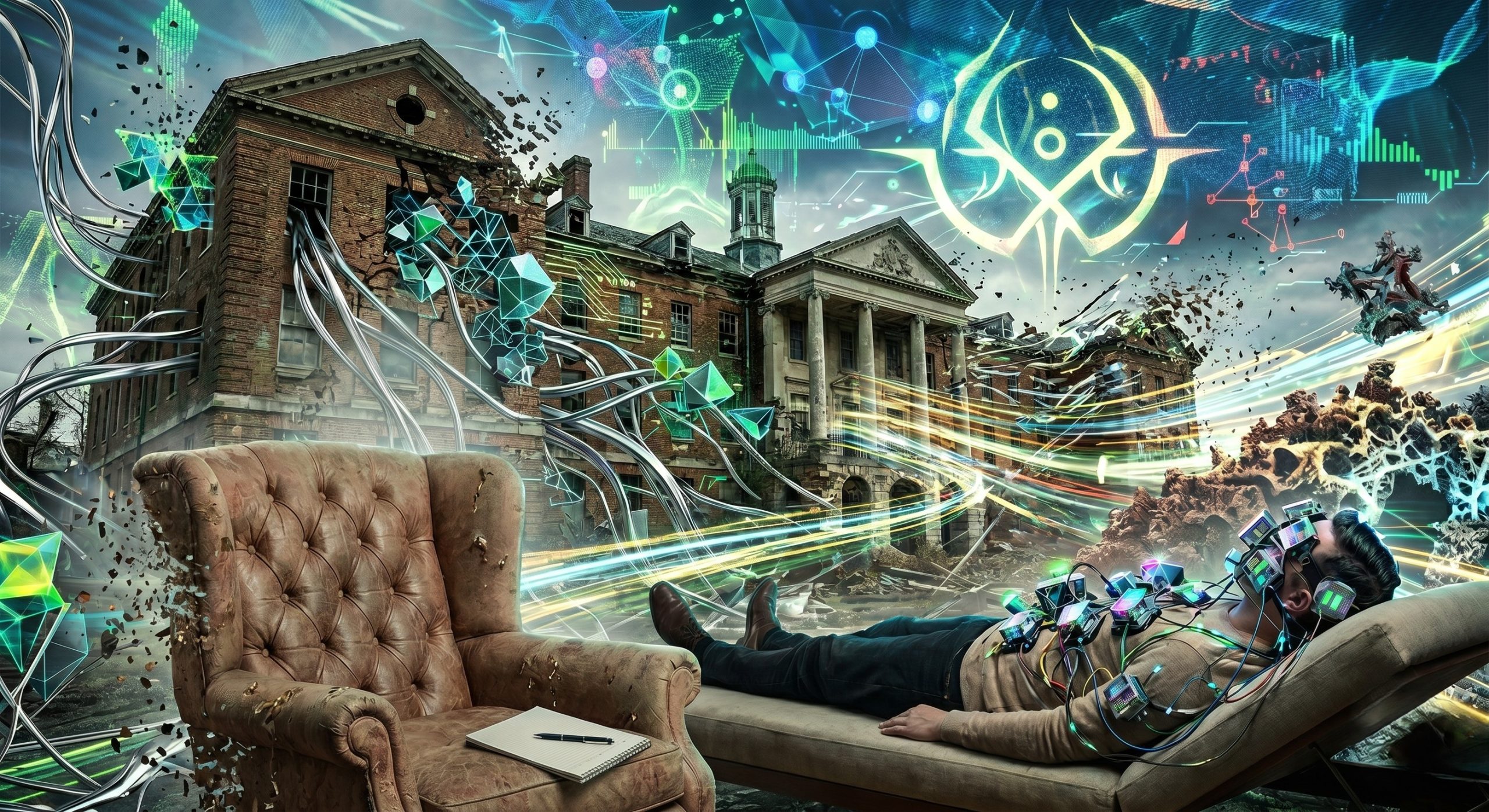
 Many of the posts and articles that I’ve read over that last twelve months or so on the topic of artificial intelligence (AI) and talking therapies begin with an assertion along the lines of ‘AI can never replace a human therapist’ and then proceed to list a number of reasons as to why this should be so. Top of list is usually ‘empathy’ (or, rather, the lack of it in AI models) and ‘human connection’ (again, something that AI models lack). The problem here, as I have argued in a number of posts on this site and others have argued elsewhere, is that both ‘empathy’ and ‘human connection’ can be simulated by AI models. This is particularly true if by ‘empathy’ and ‘human connection’ we are really referring to the transferential nature of human-AI relationships. From a Lacanian perspective this essentially means that human subjects are placing the AI ‘therapist’ in the position of the subject-supposed-to-know.1
However, this should really not come as a surprise to anyone because the subject-supposed-to-know is a position not a person. In other words, a book, a website, a work of art – or a large language model (LLM) for that matter – can occupy this position as much as it can be occupied by another human subject. In fact, the term ‘simulation’ is something of a misnomer here because a transferential relationship is structural, that is, a (differential) relationship between signifiers; in Lacanian terms it is a relationship within the Symbolic register. A true simulation, at least in the Baudrillardian sense, is in the realm of the Imaginary. This is because, if we are to take seriously Baudrillard’s claim that a simulation is a copy without an original,2 this is only possible within the realm of a closed world of meaning; that is, where the sign has lost contact with any kind of (external) referent.3
In spite of the rear-guard action of some Lacanians, I think there is little doubt that there exists an algorithmic unconscious which can operate without any human presence.4 In essence this means that in structural terms the therapeutic relationship itself can operate without human presence. In one sense, of course, this appears to be an absurd proposition: how can there possibly be a therapeutic relationship without a human presence? However, this brings us to the crux of the matter: AI exposes, brings to light, fundamental questions concerning the nature of human being and relationships, including therapeutic ones. In other words, AI forces us to rethink and question everything we thought we knew about what it is to be human and what constitutes human relations.
From a Lacanian position, and especially one (as is mine) informed by the teachings of the ‘late’ Lacan,5 the key point is not the extent to which AI can ‘replace’ various types of human relationships (including therapeutic ones) but, rather, the limits of such interactions themselves, regards of whether they are ‘human’ or ‘AI’. And what I’m specifically focusing on here is the limits of language and meaning; or, more precisely, the limits of language as a carrier of meaning. Although I’ve discussed this issue elsewhere,6 it’s important to emphasise that this is not just about the limits of AI models but the limits of language itself, regardless of whether such a language is being ‘spoken’ by a human being or an AI model. This links back to an even more fundamental question: that of the relationship between language and the Lacanian Real; and, very closely connected to this, the relationship between language and trauma.
One of the problems with psychotherapy, human or otherwise, is that its primary focus is on meaning. As I have argued at length elsewhere a great deal of the work of therapy is on the construction of narrative; and, more specifically, on the construction of trauma narratives.7 In other words, psychotherapy supports the subject in giving meaning to meaningless (traumatic) experiences. However, this is a problem insofar that meaning creates its own limit. This is because something always escapes signification; something of the Real, something traumatic. And it is not simply a case of constructing ever more meaning in the vain attempt to ultimately ‘fix’, once and for all, the meaning of a particular experience, a particular trauma. On the contrary, the more meaning the more trauma. This is hardly surprising if we think of language as the bearer of the Real in the form of jouissance.8
How, though, does this relate to the question of transference that I touched upon earlier? Or, to put it another way, what has transference got to do with language and, more specifically, with meaning? One way to approach this question is in terms of how the subject-supposed-to-know is essentially a discursive construction; that is, a fiction created by the analysand. This is another way to understand the non-ek-sistence of the Other. In other words, the transferential relationship is a construction of language. It is also important to point out that here we are in the realm of the transferential unconscious and, for want of a better term, the transferential Other. This transferential unconscious/Other is essentially the condition for the construction of the subject’s history, their narrative. But this (structural) relationship contains the seeds of its own destruction in the form of an excess; an excess of jouissance.
At some point in a psychoanalysis the analysand (sometimes) comes to realise that the subject-supposed (to know) is simply that: a supposition, a fiction (albeit a necessary one). But how does this happen? At some stage in the analysis the subject’s (analysand’s) narrative collapses in upon itself due to the weight of its internal contradictions. In other words, the subject’s story, their history, simply becomes unsustainable, meaningless. And the reason this happens is because, as I noted earlier, something is always escaping meaning. In fact, we might even say that there is always something excessive within meaning, which in my book Traumatic Neurosis Revisited I describe as drive-jouissance.9 Another way of expressing this is to say that at some point in their analysis the subject becomes traumatised by their own trauma narrative.
But what has this got to do with AI ‘therapy’? Exactly the same, I would argue, as it has to do with human therapy. The point I’m driving at in this argument is that it is the structure of the therapeutic relationship itself that undermines itself, regardless of the ‘entities’ that comprise such a relationship. In other words, it doesn’t matter whether the therapeutic relationship is human-to-human or human-to-AI model; in the end it will succumb to the Real (trauma). And what the critique of AI therapy does, somewhat ironically, is to expose the limits of the therapeutic relationship itself, even if the original purpose was to show how AI could never replace human-to-human therapy.
Notes and references
- Jacques Lacan, The Four Fundamental Concepts of Psycho-Analysis (Penguin, 1979).↩
- Jean Baudrillard, Simulacra and Simulation (The University of Michigan Press, 1994).↩
- Jean Baudrillard, The Transparency of Evil: Essays on Extreme Phenomena (Verso, 1993).↩
- See for example: Luca Possati, The Algorithmic Unconscious: How Psychoanalysis Helps in Understanding AI (Routledge, 2021). Possati argues that the unconscious is not exclusively human but is inherently tied to technique and technology. This reference is crucial for the claim that an ‘algorithmic unconscious’ exists independently of human presence, as it reinterprets Lacanian structures within the context of machine behaviour and autonomous systems. For a critique of Possati’s argument see: Eric Anders, ‘The Myth of the Algorithmic Unconscious: AI, Psychoanalysis, and the Undecidability of Language’. Undecidable Ucs, 19 March 2025. https://www.undecidableunconscious.net/post/the-myth-of-the-algorithmic-unconscious-ai-psychoanalysis-and-the-undecidability-of-language. ↩
- See for example: Jacques Lacan, The Seminar of Jacques Lacan Book XX 1972-1973: Encore, ed. Jacques-Alain Miller (WW Norton & Co, 1999). This seminar represents the start of Lacan’s shift toward the Real and the failure of the Symbolic. It is relevant here because it addresses the limits of language and the non-ek-sistence of the Other, providing the theoretical basis for questioning the boundaries of both human and AI relationships.↩
- Leslie Chapman, Traumatic Neurosis Revisited: Drive-Jouissance and the Wounds of Life, The Palgrave Lacan Series (Palgrave Macmillan, 2025).↩
- Leslie Chapman, ‘Psychoanalysis as the Rejection of Meaning’, 29 February 2024, https://therapeia.org.uk/ttr/2024/02/29/psychoanalysis-as-the-rejection-of-meaning/.↩
- Jacques Lacan, The Other Side of Psychoanalysis: The Seminar of Jacques Lacan Book XVII, trans. Russell Grigg (W.W Norton and Co., 2007). In this seminar, Lacan elaborates on the relationship between the master signifier and jouissance, describing how the Symbolic order “carries” an excess that cannot be fully symbolized. This supports the claim that language is the bearer of the Real, as it is the very process of speaking that produces the traumatic surplus known as jouissance.↩
- Chapman, Traumatic Neurosis Revisited.↩
This article is part of a broader research project on The Algorithmic Other. For a complete overview of how Lacanian theory addresses the challenges of AI and digital simulation, please visit the AI and Psychoanalysis Hub.
Last updated: November 5, 2026
As automated systems and algorithmic metrics increasingly format contemporary life and mental health, psychoanalysis provides an unscripted, human space to address what resists calculation. For those individuals who are navigating personal impasses or digtial burnout I can offer online consultations. Please click here for further information.