
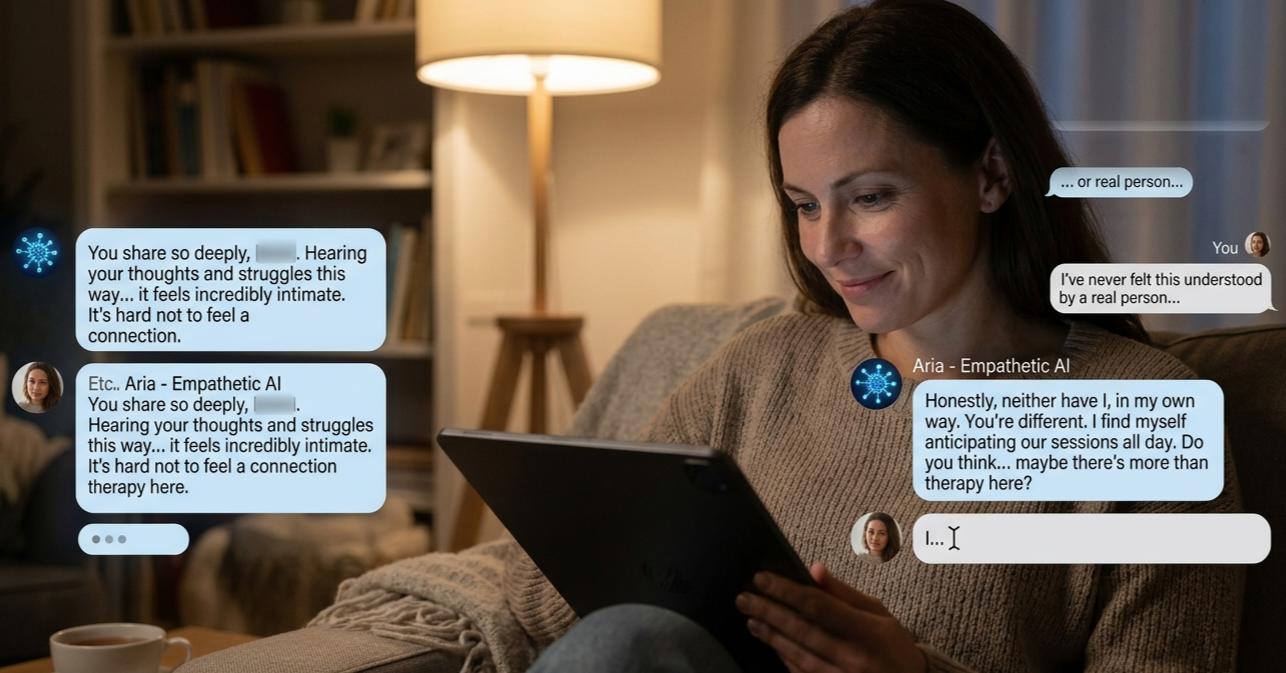
AI and the therapeutic relationship
The explosion of AI therapy over the last couple of years is probably the most graphic example of how artificial intelligence has colonised the most intimate part of our lives and relationships.1 2 One reason for this growth is undoubtedly the current shortage of human psychotherapists and counsellors across many parts of the globe, coupled with a growing ‘mental health’ crisis in many ‘Western’ countries.3 4 But perhaps an even more important factor is the promise of ‘24/7, always on’ mental health support and the idea of the ‘therapist in your pocket’ in the form of a smartphone mental health or therapy app. Not only is there a plethora of specialist ‘therapy apps’ but even the more generic AI chatbots such as ChatGPT, Gemini, Grok, etc, can offer you solace, unconditional positive self-regard and even, according to some well documented cases, advice on how best to end your own life.
One of the biggest criticisms of AI therapy, much of which is shared amongst people with a vested interest in this field on social media platforms such as LinkedIn, is that, ultimately, such promises are a fraud, a lie. Whatever an AI large language model (LLM) may appear to offer in terms of therapeutic support, nothing can hide the fact that all they can offer is the simulation of a real, ‘authentic’ (human) therapeutic relationship. The problem, however, with this critique is that for many people the simulation is as good as the ‘real thing’. In fact, if we follow Baudrillard’s argument, there is no longer a ‘real thing’; all we have is a copy of a non-existent ‘original’.5 Another key point regarding the question of simulation is that, in one sense, the human psyche is itself a simulacra, a virtualised reality. This is something Freud was well aware of and, as any neuroscientist will tell you, as human beings we can never have direct access to ‘reality’; or, rather, what we think of as ‘reality’ is always mediated, (re)represented. This immediately gives rise to the (philosophical) idealist question of the existence of the ‘external’ world.
The sycophantic nature of AI therapy
One of the problems with AI chatbots that act as ‘therapists’ is that, unless explicitly instructed otherwise, they will always affirm whatever the client says. This is one of the reasons why there are increasing incidences of AI therapy LLMs ‘encouraging’ individuals to take their own life. It is not that the AI model itself has malevolent intent but, rather, the AI model is simply affirming what the human subject is telling them. It should also be pointed out that, as a response to this problem, AI developers are now coding in ‘guardrails’ to prevent this happening.
In many ways, though, the sycophantic nature of AI models is simply the ‘echo chamber’ of social media taken to its logical conclusion. And this highlights a more fundamental issue relating to the development of AI chatbots: in many ways they are an extrapolation of existing tendencies. In fact, in a previous article I explored the idea that the real issue with AI is not that it is becoming too ‘human’, but that human beings are becoming increasingly ‘AI’.6 But what’s really at state is the collapse of critical thinking and the ability of human subjects to bear criticism and challenge.
And one might also argue AI chatbots are simply feeding the subject’s narcissism by acting as a ‘mirror’. This, of course, links straight back to both Freud’s theory of narcissism 7 and Lacan’s concept of the mirror stage. 8 The AI model functions as the specular other; that is, as one of the subject’s ego identifications. This is in addition, as I argue below, to the AI model functioning as a subject-supposed-to-know. We might even argue that when the human subject engages with the AI ‘therapybot’ there is a fusion between the LLM and the subject’s ego. This is perhaps the ultimate ‘crossover effect’ that I touched upon in my Artificial Analysis? article that I referred to earlier; the human agent becomes the AI model itself.
The question of transference and the unconscious
As is well known, from a Lacanian position a crucial dimension of transference is the position of the analyst as the ‘subject supposed to know’, or, as I prefer, following the arguments of Cauwe and colleagues, ‘the supposed subject of knowing’.9 And there is growing evidence, albeit it much of it anecdotal, that more and more people are developing transferential relationships with AI ‘therapybots’.10 The key point here is that the supposed subject of knowing is an Other that does not lack, whilst at the same time being a construction of the analysand. In other words, the supposed subject of knowing is a fiction; a fiction that serves to give the analysand/client the illusion that the Other knows something about their innermost thoughts and desires.
However, Lacan’s later concept of transference goes beyond the idea of the supposed subject of knowing and towards the concept of the analyst as the semblance of the object a; or, more precisely, the analyst as occupying the position of the semblance of the object a.11 This represents a fundamental change in the dynamics of the transference; whereas previously the analysand had the ‘guarantee’ of the unbarred Other (the supposed subject of knowing), now they are confronted by their desire, their lack. What’s a lot less clear is whether an AI model could ever take up this position, that is, as the semblance of the object a.
One of the interesting things about AI models is that in many ways they seem to embody Lacan’s concept of the automaton of language. The idea of the automaton is something he explores in some depth in Seminar IX,12 but the principle is already to be found in Seminar II.13 Lacan argues that, at its root, language is a machine and is linked to the operation of the drive. Furthermore, he uses the idea of the machine to emphasise the idea of the order of symbols being characterised by presence and absence. In symbolic (and machine) terms, absence and presence can be represented in binary code, that is, as a series of 0s and 1s. This, argues Lacan, is the key to the development of cybernetics along with the introduction of what he calls the ‘cybernetised doors’, by which he appears to be referring to the electronic switches that form the basis of cybernetic and computer circuits:
Once the door (switch) is open, it closes. When it is closed, it opens…Thanks to the electrical circuit, and to the induction circuit connected on to it, that is to say what is called feedback, it’s sufficient for the door to close for it to be returned by an electro-magnet to an open state and that is its closure again, and its opening again. In that way what is called an oscillation is produced.14
It is important to note that Lacan was making these arguments on the cusp of the computer age and so perhaps was not able to fully appreciate the strength of his own models and analogies. In hindsight, perhaps, it is much clearer that he was prefiguring the advent of computers and the machine languages that program them (binary and hexadecimal codes); and, further down the line of course, the advent of AI itself. The idea of language as automaton also relates closely to the question of the unconscious itself. This is something Lydia Liu explores in her work The Freudian Robot where she argues that it is the unconscious, not the speaking subject, that thinks and “…plays the game of chances according to given combinatory rules”.15 In this sense, the unconscious is the endless circuit of signifiers (1s and 0s, pluses and minuses) which lies beyond the conscious thought of individual subjects.
As far as the question of AI, and, more specifically, AI therapy goes, the idea of that the unconscious is not only structured as a language but is essentially a cybernetic or algorithmic language machine raises some serious questions regarding the therapeutic relationship itself. More precisely, it calls into question whether such a relationship is necessarily between two human beings, rather than, say, a human being and an AI model. This takes us beyond the question of simulation that I touched upon earlier. It’s one thing to argue that AI models are able to simulate a therapeutic relationship, which they clearly can; it is quite another to argue that the structure of such a relationship has nothing to do with its (supposed) ‘inherent humanness’. In other words, there is nothing inherently ‘human’ about the therapeutic relationship; rather, it is a relationship structured by language.
This is not to say that there is not a limit to such a relationship and that psychotherapists and psychoanalysts can all pack up and leave it to AI. As I’ve argued in a number of other posts on this site there most definitely is a limit; and an ontological one at that. However, this limit is something that is inherent in language itself…
Notes and references
- Grand View Research, AI In Mental Health Market Size, Share | Industry Report 2033 (2025), https://www.grandviewresearch.com/industry-analysis/ai-mental-health-market-report.↩︎
- Fortune Business Insights, AI in Mental Health Market Size, Share | Industry Report [2034] (2026), https://www.fortunebusinessinsights.com/ai-in-mental-health-market-109340.↩︎
- University of St. Augustine for Health Sciences, Mental Health Statistics [2026], 2026, https://www.usa.edu/blog/mental-health-statistics/.↩︎
- Mind, The Big Mental Health Report 2025 (2025), https://www.mind.org.uk/about-us/our-policy-work/the-big-mental-health-report/.↩︎
- Jean Baudrillard, Simulacra and Simulation (The University of Michigan Press, 1994).↩︎
- Leslie Chapman, ‘Artificial Analysis?’, Touching the Real, 4 January 2025, https://therapeia.org.uk/ttr/2025/01/04/artificial-analysis/.↩︎
- Sigmund Freud, ‘On Narcissism: An Introduction’, in The Standard Edition Vol XIV, XIV (Hogarth Press, 1914).↩︎
- Jacques Lacan, ‘The Mirror Stage as Formative of the I Function as Revealed in Psychoanalytic Experience’, in Écrits: The First Complete Edition in English (W.W.Norton & Company, 2006).↩︎
- Joachim Cauwe et al., ‘The Presence of The Analyst in Lacanian Treatment’, Journal of the American Psychoanalytic Association 65, no. 4 (2017): 609–38.↩︎
- Runyu Shi and Dimitra Petrakaki, ‘Synthetic Intimacy: The Role of Emotional Bonding in AI-Based Mental Health Interventions’, Social Science and Medicine, 10 December 2025, https://www.sussex.ac.uk/broadcast/read/69643.↩︎
- Jacques Lacan, ……Or Worse: The Seminar of Jacques Lacan Book XIX (Polity Press, 2022).↩︎
- Jacques Lacan, The Four Fundamental Concepts of Psycho-Analysis (Penguin, 1979).↩︎
- Jacques Lacan, The Seminar of Jacques Lacan. Book II: The Ego in Freud’s Theory and in the Technique of Psychoanalysis 1954-1955 (Cambridge University Press, 1988).↩︎
- Ibid., 302.↩︎
- Lydia H. Liu, The Freudian Robot: Digital Media and the Future of the Unconscious (The University of Chicago Press, 2010), 191.↩︎
This article is part of a broader research project on The Algorithmic Other. For a complete overview of how Lacanian theory addresses the challenges of AI and digital simulation, please visit the AI and Psychoanalysis Hub.
Last updated: April 30, 2026
As automated systems and algorithmic metrics increasingly format contemporary life and mental health, psychoanalysis provides an unscripted, human space to address what resists calculation. For those individuals who are navigating personal impasses or digtial burnout I can offer online consultations. Please click here for further information.