
Introduction
Lacan’s theory of the four discourses is first articulated in Seminar XVII: The Other Side of Psychoanalysis which he presented between December 1969 and June 1970.[1] However, it is in his Milan lecture in May 1972 where Lacan gives what is probably the most succinct ‘definition’ of the term ‘discourse’: “What is a discourse? It is what, in the order . . . in the ordering of what can be produced by the existence of language, makes some social link function.”[2] In other words, a discourse is a form of the social relation or social bond. Furthermore, each of the four discourses has the same structure:[3]
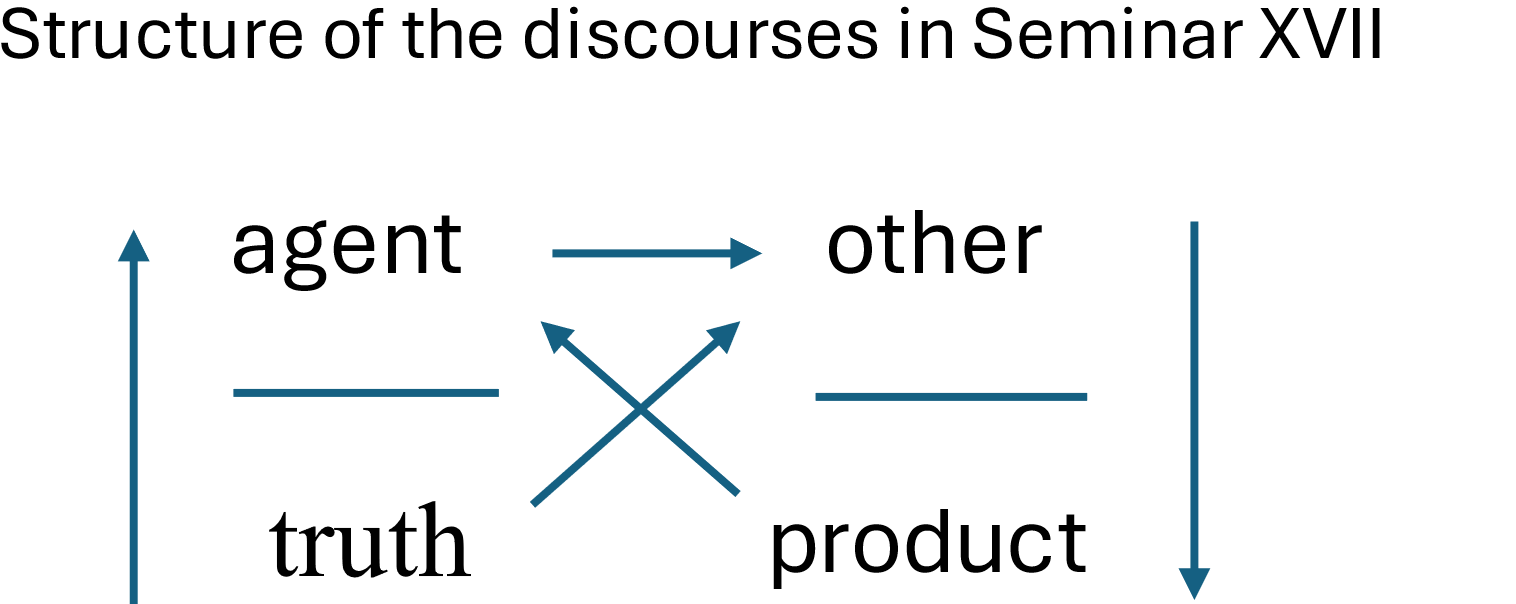
Quoting from Serge Lesourd’s 2006 on Lacan discourse theory, Phillipe Gendrault explains this structure as follows:
The one speaking [the agent] addresses himself to the other from the truth sustaining the speaker unconsciously [the vertical arrow on the left-hand side]. This truth, through the various symptoms of daily life (slips of the tongue, parapraxes, etc.), but also through pathological symptoms, also addresses itself, although indirectly, to the other. The other, then, responds to the subject with a production that can be other than linguistic . The produced effect then returns to the discursive agent [the diagonal arrow from product to agent] and the circuit starts again.[4]
It is important to note that the two terms below the horizontal bar (truth and product) are ‘masked’ by ones above the bar (agent and other). In other words, and at a superficial level, the structure of the discourse would appear to simply represent the effect of the agent on the other. However, by bringing in the lower part of the structure and the vertical and diagonal arrows, it becomes clear that there is a complex dynamical relationship in play here, much of it at the level of the unconscious.
The discourse of the master
Although in Lacan’s original formulation there are four discourses, they are all variants of what Lacan names the discourse of the master:
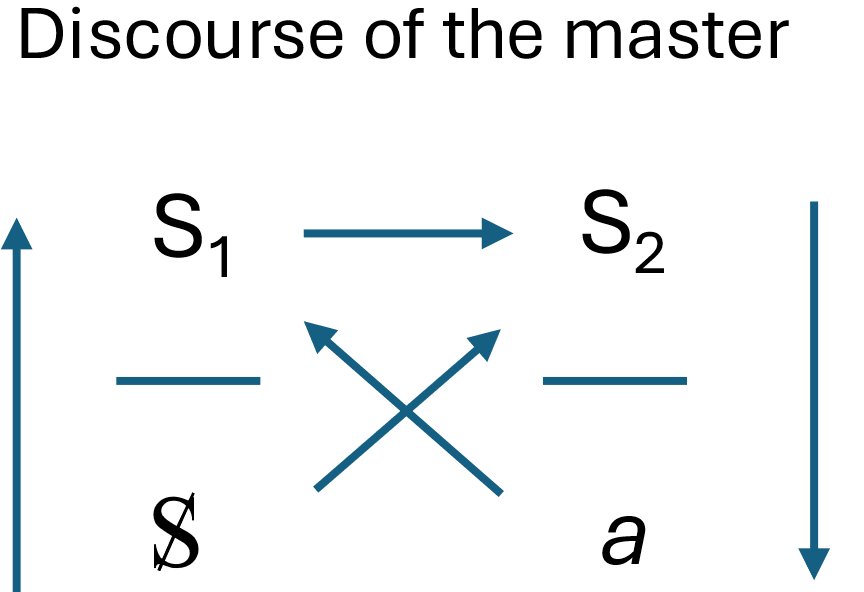
And it is clear from Seminar XVII that the master’s discourse is an elaboration of Hegel’s master-slave dialectic, but in far more abstract and structural terms. Looking at it this way the discourse can be read as follows: the master (S1) puts the slave (S2) to work who produces a surplus (a) which can then be appropriated (enjoyed) by the master. However, just as the surplus (a) is hidden from the slave/worker so the master’s division as subject (  ) is hidden from them.
But why  ? It should always be kept in mind that in this formulation, the terms ‘agent’ and ‘other’ (‘master’ and ‘slave’ in this instance) refer to structural positions, not actual people. So S1 refers to the master signifier, not an actual master and S2 refers to the network of signifiers (knowledge, meaning) not an actual slave/worker. S2 is essentially shorthand for the series (or network) of signifiers (S1…S2…Sn) which is what constitutes the Symbolic register and is also the domain of knowledge. But in the discourse of the master, it is the slave/worker who in position of knowledge, not the master. In other words, it is the slave who has the knowledge, the know-how, which the master puts to work for their (the master’s) own benefit. This is why, in the Hegelian dialectic, and especially in it rendition by Alexandre Kojève,[5] it is through work that the slave becomes free. The master is essentially ignorant, and, somewhat paradoxically, impotent, because they only want to enjoy the fruits of the slave’s labour (the surplus jouissance).
The discourse of the university
However, this is only the beginning of the story because there are (at least) three other discourses to consider. As I mentioned earlier, these other discourses are all variants of the discourse of the master and the one that is perhaps closest to it is the discourse of the university:
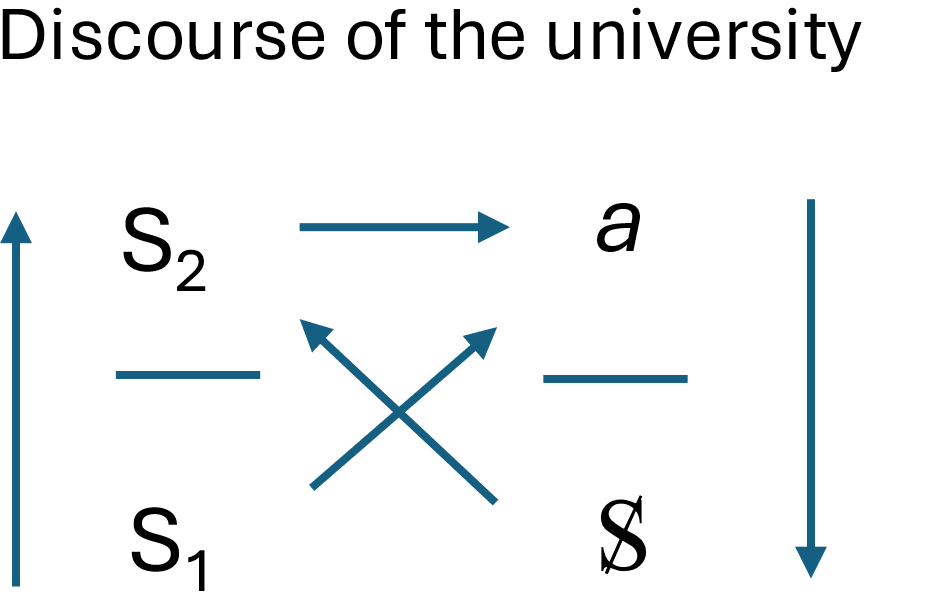
Here, knowledge itself (S2) is in the position of the agent and acts upon a in the position of the other. But ‘beneath’ S2 lurks the figure of the master (S1) which means that the university discourse is still one of mastery. And essentially for Lacan this is the structuring of the modern world of science and technology. But why is a in the position of the other and how does it ‘produce’  ? If we think about the operation of the actual university itself (although the discourse of the university extends far beyond its physical walls) then the body of teaching and knowledge (lecturers, texts, and so on) are imparted to students. But such an imparting of knowledge simply divides the subject (the student) further which pushes (drives) them to seek more knowledge in order to find some kind of ‘completion’ as a subject. At some point, of course, they are likely to gain enough knowledge to be able to graduate (literally and metaphorically) to the position of S2 and so become a master (masquerading as an academic) themselves.
However, this still doesn’t explain how the student is in the position of the object a in the first place. But if we recall that in the master’s discourse, S2 ‘produces’ a (surplus jouissance) then this suggests there is something rather odd about the university discourse. In fact, it’s not so much odd as showing that there has been a rotation (counter-clockwise) of the master’s discourse and in the process the ‘hidden’ product of such a discourse has come to light. In an interview on the steps of the Pantheon (which is included in Seminar XVII) Lacan addresses the question of university discourse and the position of object a as follows:
In the articulation that I describe as the university discourse the a is in the place of what? In the place, let’s say, of the exploited in the university discourse, who are easy to recognize – they are students. In focusing one’s reflection on this place in the notation many things can he explained in these singular phenomena that, for the moment, are happening around the world. To be sure. one has to differentiate between the emergence of its radicality – this is what is happening – and the way in which the university’s function has become clogged up, blocked, maintained – this can last for a very long time. The university has an extremely precise function, in effect, one that at every moment is related to the state we are in with respect to the master’s discourse – namely, its elucidation. As a matter of fact, this discourse has been a masked discourse for a very long time. Through its internal necessity it will become less and less masked.[6]
There are a number of interesting (and important) things about this quote. Firstly, the historical context: Lacan made these comments in May 1970, barely two years after the ‘events’ of 1968 in Paris, and whose effects were still being felt very acutely. As has been well documented, the ‘events’ were to a large extent driven by the crisis in the French university system in particular, and a broader malaise in Western academia in general. This was the time when students really thought that they, in collaboration with the proletariat, could change the world. The reason this failed to happen can be partly explained by the second interesting aspect of this quote: the reference to the function of the university discourse, that is, the elucidation, the clarification, of the discourse of the master.
At this point it is important to reiterate that when Lacan refers to the discourse of the university he is not talking simply about physical buildings called universities, or even about something called ‘academia’. Rather, he is referring to the use of knowledge as a means to mastery. Whereas in the discourse of the master, the agent (the master, S1) appropriates the surplus produced by the slave/worker’s knowledge (know-how), in the discourse of university the agent is knowledge itself (S2) who acts on the one who wishes to learn (student, pupil, trainee, etc) and who is in the position of object a. That there is something rather peculiar about this position is alluded to by Lacan when he refers to “…the close relationship that exists between the student’s position of always being, in the university discourse, in a more or less masked manner, identified with this object a, which is charged with producing what? The barred S that comes next on the lower right-hand side”.[7]
What, though, is the student doing in the position of the object a in the first place and, in turn, how did the object a end up in the position of the Other[8] in the structure? Furthermore, how does the object a ‘produce’ the barred subject ( ) in this discourse? At this point it is worth remembering that whereas in the master’s discourse the knowledge (the slave’s know-how) is in the position of the Other (on the upper right-hand side of the structure), in the university discourse it is on the upper left-hand side in the position of the agent. And it is also important to note that by ‘knowledge’ we are not talking about some abstract and static ‘entity’ but a dynamic process; knowledge is essentially a ‘product’ in itself, one that is continually produced in ‘knowledge factories’ (universities, research establishments, etc). And such a product has its own ‘by-product’ (surplus jouissance, the object a). In the discourse of the university this by-product’ moves ‘up’ from beneath the bar to the position of the Other. Anyone who has ever been a student of some kind, including being on a few days’ training course, will know that the process of learning can be quite unsettling and the reason for this, I would argue, is precisely because one is in the position of object a and the effect of being unsettled is subjective division (
 ). In order to ‘overcome’ such a division the student seeks more knowledge (S2) which ‘produces’ more surplus-jouissance, and so it goes on. Of course, one the rewards such an experience is that eventually one will become a teacher, an imparter of knowledge themselves, and will thus be able to move from object a to S2, from the Other to the agent.
The critical point here is that for Lacan, the discourse of the university is currently the dominant discourse of society, having replaced the discourse of the master. It is not only the discourse of science (knowledge) but also the discourse of bureaucracy; or, to be even more precise, technocracy. This is the discourse of rationality and calculation, where everything is measured, transformed into algorithms, evaluated and quantified.
The discourse of the hysteric
But what of the other two discourses? For Lacan, the discourse of the hysteric is, interestingly enough, the true discourse of knowledge:
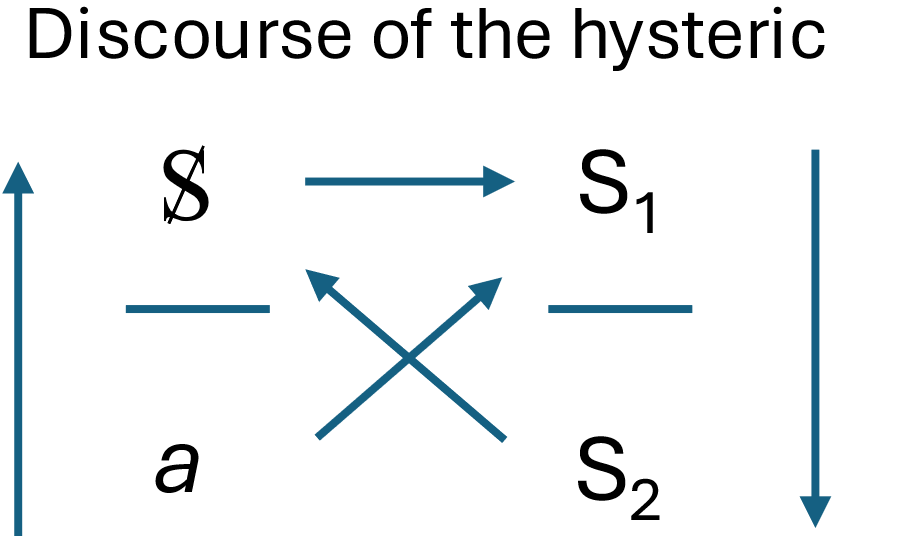
This is because it essentially ‘unmasks’ the truth of the master’s discourse. As Lacan puts it:
It’s simply that the hysteric’s discourse reveals the master’s discourse’s relation to jouissance, in the sense that in it knowledge occupies the place of jouissance. The subject himself, the hysteric, is alienated from the master signifier as he whom this signifier divides…he who refuses to make himself its body. [9]
To understand what Lacan is getting at here it is helpful to reproduce an alternative form of the structure of the discourses in Seminar XVII [10]:
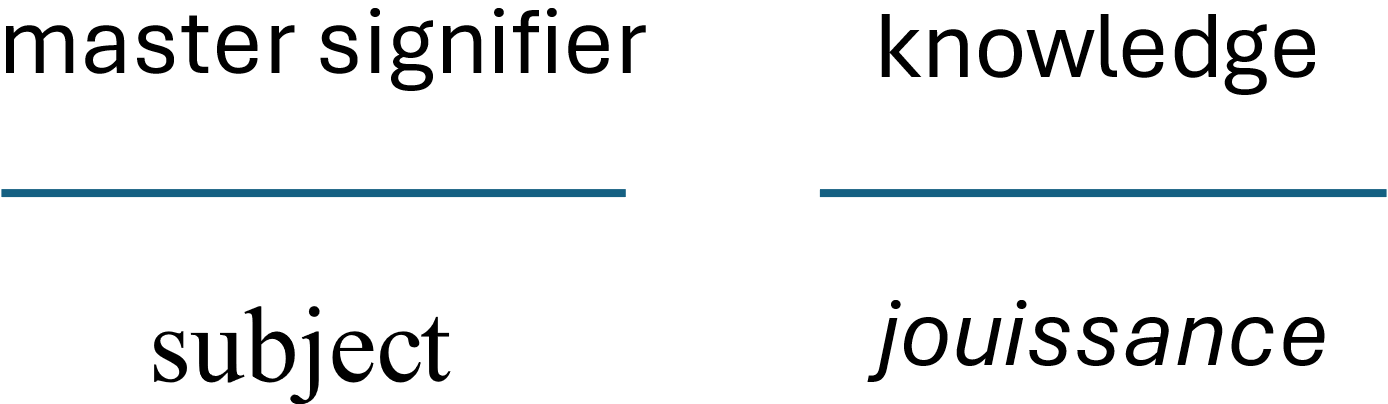
This makes it clear why Lacan is arguing in that Seminar that the all the discourses are essentially variations of the master’s discourse. In the hysteric’s discourse knowledge (S2) ‘drops’ to the position of (surplus) jouissance whereas the barred subject ( ) is ‘elevated’ to the position of the master signifier and therefore puts the hysterical subject ‘in control’, so to speak, as the agent. The key point here, as Lacan argues in an earlier lesson in the Seminar, is that knowledge is a means of jouissance. This is developed out of his idea that jouissance is an effect of repetition; and what is being repeated, through the circulation of the drive, is what Lacan calls the unary trait. Lacan originally introduced the concept in Seminar IX and although the unary trait refers to the isolated signifier, he explains that he prefers the term ‘unary’ to ‘single’ (as in ‘single signifier’) because he sees the unary trait in terms of a number.[11] Raul Moncayo (who uses the term ‘trace’ instead of ‘trait’) explains that it is a term “…that Lacan borrowed from mathematics following Freud’s use of the unary trait to explain a form of identification” and that “Once established, the unary trace becomes a system for non-diacritical marks that are not yet integers”.[12] Such traces or traits are used to represent the concept of number and examples include tally marks and vertical bars which are repeated (for example, |||| represents the number four).
In Seminar XVII Lacan argues that knowledge “…is dominated, articulated by purely formal necessities, the necessities of writing, and in our day this leads to a certain type of logic.” This ‘certain type of logic’, Lacan explains, is modern logic and although it might be regarded as the most ‘purified’ form of knowledge, it is the same knowledge that appears, in the guise of repetition, in the analyst’s consulting room. Furthermore, according to Lacan: “This knowledge here reveals it roots in the fact that in repetition, and in the form of the unary trait to begin with, it is found to be the means of jouissance – precisely insofar as jouissance goes beyond the limits imposed, under the term of pleasure, on the usual tensions of life.” [13]
The essence of Lacan’s argument here is that the signifier (the unary trait) is an apparatus of jouissance, and this is made clear (‘unmasked’) in the discourse of the hysteric: S1 (the unary trait) ‘produces’ S2 (knowledge) as jouissance. Furthermore, this discourse is also a way to represent the hysteric’s transference to the subject-supposed-to-know (S1), who is in the position of the Other.
The discourse of the analyst
There is, however, one more discourse to consider (at least in Lacan’s original formulation), which is that of the analyst:
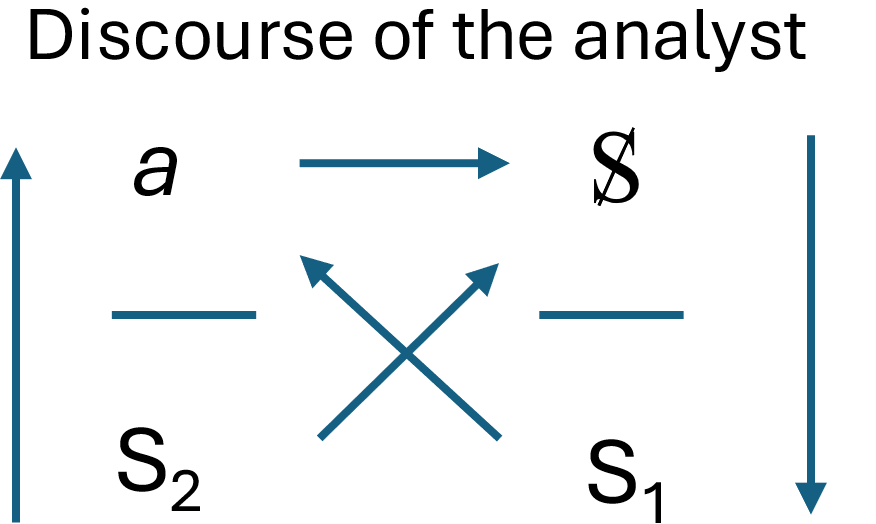
This is essentially the inverse of the discourse of the master. In his paper on the discourse of the capitalist Stijn Vanheule explains:
…in the discourse of the analyst, the analyst qua agent confronts the other with a so-called object a, logically notated a. The object a refers to a drive or jouissance-related remainder that cannot be named and that fuels desire. For example, the analyst’s silence, which often baffles the analysand who expects reciprocity in the interaction, can function as an object a… By occupying the place of the object (a) the analyst creates a place where, via free associative speech, subjective division can be articulated ($). In order to pay close attention to the singularity of the patient the analyst puts aside pre-established ideas about patients and pathologies (S2), such that key signifiers that mark the analysand’s subjectivity (S1) can be formulated, which fuels the analyst’s positioning qua object a.[14]
The key thing to remember here, as Lacan notes in Seminar XVII, in this discourse, the analyst, as object a, is in the position of the master (signifier). But the truth of this master (masquerading as object a) is knowledge (S2). However, as Lacan points out:
The only thing is that what has to be understood about this schema – as was already indicated when in the master’s discourse S2 was put in the slave’s place, when in the modernized master’s discourse [the university discourse] it was then put in the master’s place – is that the knowledge is not the same.[15]
In other words, whereas in the master’s discourse the knowledge (as know-how, savoir) is in position of the slave (as Other) which the master ‘puts to work’, in the analyst’s discourse it constitutes the ‘know-how’ of the analyst. In other words, or at least how I understand it, although the analyst occupies the position of the object a (which, of course, is actually in the position of the master) this is a deliberate strategy on the part of the analyst in order to effect the division of the subject (the analysand).
However, in doing so this somewhat belies the idea that the analyst’s discourse is the only truly ‘revolutionary’ one in the sense that it is the only discourse that can challenge and undermine the discourses of the master and the university. It is ‘revolutionary’ only in the sense that it is the result of a revolution (a turning around) of the discourse of the master. At the end of the day, as Lacan was well aware, it is still a variant of the master’s discourse, as are the discourses of the university and the hysteric.
A discourse of the capitalist?
And perhaps even more surprisingly (and possibly shocking for some people) is Jacques-Alain Miller’s idea that the discourse of the analyst is, in fact, what he terms the hypermodern discourse of civilisation.[16] It should be noted at this point that Miller describes such an idea as a ‘fantasy’, but as we know, in psychoanalysis the term ‘fantasy’ has a rather different meaning than it does in popular discourse. Furthermore, it is also worth noting that the relation a →  looks suspiciously like the (reversed) form of the fundamental fantasy
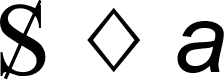 .
The first thing to note, as does Miller, is that in the analyst’s discourse the object a is in the dominant position, that is, of the agent. As Miller puts it “…I wondered: might the objet petit a be – how can we put it? – the compass of civilisation of today? And why not? Let’s try to see what the principle of the hypermodern discourse of civilisation is…In this possible discourse of civilisation, we can give this object the dominant place”[17]
And, argues Miller, this ‘dominant’ object ‘imposes’ itself on the subject who in turn produces an ‘evaluation’ of themselves (S1). This is the world of ‘self-assessment’, ‘self-help’, continually measuring one’s own ‘performance’. And the whole purpose of such an exercise is to see how close one is coming to ‘fulfilment’. In other words, in this discourse object a represents what is lacking in the subject, what fuels their desire. A bit more self-help, a bit more exercise, a bit more analysis, and one will be ‘complete’, ‘fulfilled’, ‘happy’. But what is hidden in all this, what is in the place truth, is the knowledge (S2) that this is all a lie. The worrying thing, however, at least for those looking to psychoanalysis as some kind of ‘antidote’ to (hyper)modern civilisation, is that the discourse of the analyst is the same as the discourse of hypermodernity, which is another way of saying it is the discourse of capitalism.
This creates a problem on at least two fronts. Firstly, and as I’ve already alluded to, it seems to undermine the revolutionary potential of psychoanalysis, insofar that the term ‘revolution’ refers to attempts to challenge and undermine the dominance of capitalist discourse. Clearly, of course, there are other types of revolution, including the perpetual revolution that is capitalism itself, but this is not my concern here. What I’m focusing on is the apparent equivalence between the discourse of the analyst and the discourse of hypermodernity (capitalism). As Miller points out:
The discourse of the analyst was formerly the analyser of the discourse of the unconscious, which was its other side – what Lacan calls the other side of psychoanalysis is the discourse of the master. The discourse of the analyst could thus analyse the discourse of the unconscious. Its interpretative and subversive power was able, in the same stroke, to exert a hold over civilisation and the phenomena of society that it had to deal with, and that we have had to deal with as well, as Lacan tried to show, since the very beginnings of antiquity.[18]
Now, however, the discourse of the analyst has itself turned upside down: “…the discourse of civilisation is no longer the other side of psychoanalysis, it is the accomplishment of psychoanalysis.”[19]
The second problem is that if the analyst’s discourse is, in fact, the discourse of (hyper) capitalism, then there seems no need for what is commonly touted as the ‘fifth discourse’, that is, the discourse of the capitalist.
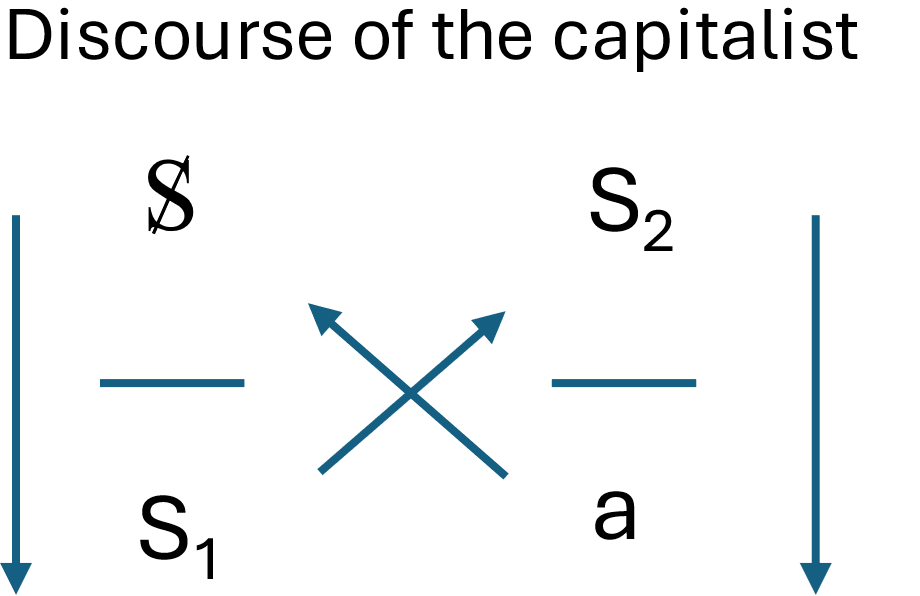
The above diagram is the one used by Stijn Vanheule, whose work I have already cited, and, like a number of other authors, he is basing it on the only known diagram, presented by Lacan as part of his 1972 Milan lecture, in which he gave a formal articulation of the discourse of the capitalist. In fact, in the transcript of the lecture, very little space is given to the discourse – at most a couple of paragraphs. Regarding the capitalist discourse itself, Lacan states:
After all, it is the cleverest discourse that we have made. It is no less headed for a blowout. This is because it is untenable. It is untenable . . . in a thing that I could explain to you . . . because capitalist discourse is here, you see . . . [indicates the formula on the board] . . . a little inversion simply between the S1 and the
. . . which is the subject . . . it suffices so that that goes on casters (ça marche comme sur des roulettes), indeed that cannot go better, but that goes too fast, that consumes itself, that consumes itself so that is consumed (ça se consomme, ça se consomme si bien que ça se consume).[20]
As Vanheule explains:
Indeed, what is structurally characteristic of the discourse of the capitalist is that while the four positions remain intact, the pathways made up by the arrows change: in all positions one arrow arrives, such that a closed circuit of arrows is created. The structural lapse that marks the four standard discourses cannot be found at the root of this fifth discourse, which, so to speak, makes it run on wheels. Yet Lacan suggests that in the end the one functioning along the lines of this smoothly running process burns himself out, and gets consumed. One idea that the above quote articulates, is that in the capitalist discourse subjectivity is corrupted. The main structural reason for this is that in this discourse, the distance between $ and a is lost: corporeal tension that is proper to surplus jouissance disturbs the subject.[21]
In other words, the capitalist discourse represents a disruption of the social bond that is retained in all four iterations of the master’s discourse. And in the process, the nature of subjectivity itself is corrupted. Perhaps another way to put it is that the capitalist discourse represents a ‘short-circuiting’ of the master’s discourse.
But perhaps what’s even more interesting, especially in the light of Miller’s arguments that I discussed earlier, is that Lacan then goes on to argue:
In truth I believe one will not speak of the psychoanalyst in the lineage, if I can say this, of my discourse . . . my analytic discourse. Something else will appear, which, of course, must maintain the position of the semblant, but nonetheless that will be . . . but that will be perhaps be called the PS discourse. A PS and then a T, which, besides, will be in complete conformity with how one said that Freud saw the importing of psychoanalytic discourse into America . . . that will be the PST discourse. Add an E, and that gives us PESTE [PLAGUE].
Up to this point it might be thought Lacan is simply reiterating Freud’s famous remark to Jung on their first transatlantic trip that they were bringing, in the form of psychoanalysis, the plague to America. However, Lacan immediately goes on to say: “A discourse that would finally be truly pestilent, wholly devoted, finally, to the service of capitalist discourse.”[22] This doesn’t sound quite like the type of plague or subversive discourse that is going to undermine capitalism; rather, it is going to be of service to it. And this is precisely what has happened with regards to the ‘Americanisation’ of psychoanalysis, particularly in the form of ego psychology, where the focus has been to help discontented citizens of capitalist societies ‘adjust’ to the demands of the market and the state apparatus that goes with it, that is, bio-politics, surveillance society, and so on.
But if Miller is right to argue that the discourse of the analyst equates to the discourse of hypermodern civilisation, that is, hypercapitalism, then do we actually need a fifth discourse at all (let alone the possibility of twenty-four discourses that Levi Bryant explores!). [23] Perhaps the only reason to introduce a discourse of the capitalist is if psychoanalysis still sees itself in opposition to hypercapitalism as opposed to being not only its servant but, in fact, its very structure.
However, all is not lost. Because in the same paper that Miller muses on his fantasy of the analyst’s discourse being the discourse of hypermodern civilisation he also writes:
Thus, Lacanian practice, which is to be invented, will not operate with reference to the discourse of the unconscious as its other side. It will operate, it is already operating through us…in a hole of the real that works, and a hole is not a lack – lack is always in its place, lack is the other name for place. Lack is the principle of all substitutions and it is even what permits use to say at a given moment: Bingo! On the contrary, Lacanian practice operates in the dimension of a failing. [24]
A hole in the Real? Psychoanalysis as a failing? What can this mean…?
Notes and references
- Jacques Lacan, The Other Side of Psychoanalysis: The Seminar of Jacques Lacan Book XVII, trans. Russell Grigg (W.W Norton and Co., 2007). ↑
- Jacques Lacan, ‘On Psychoanalytic Discourse’, in Lacan in Italia 1953-1978 (La Salmandra, 1978), 12. Please note: all page numbers refer to the English translation by Jack W. Stone. ↑
- Please note: this and subsequent diagrams are taken from Stijn Vanheule’ paper, ‘Capitalist Discourse, Subjectivity and Lacanian Psychoanalysis’, Frontiers in Psychology 7 (2016) ↑
- Phillipe Gendrault, ‘Lacan’s 5th Discourse: Introducing the Capitalist Discourse’, 7. ↑
- Alexandre Kojève, Introduction to the Reading of Hegel. Lectures on the Phenomenology of Spirit (Cornell University Press, 1969). It was through his attendance at Kojève’s lectures in the 1930s that Lacan developed his particular reading of Hegel and especially his master-slave relationship. ↑
- Lacan, Seminar XVII, 147-48. ↑
- Ibid., 148. ↑
- Please note: although many commentators write ‘other’ with a small ‘o’, in Seminar XVII Lacan uses capital ‘O’ for the Other.↑
- Ibid., 94. ↑
- Ibid., 92. ↑
- Jacques Lacan, The Seminar of Jacques Lacan Book IX 1961-62: Identification, trans. Cormac Gallagher (Unpublished translation by Cormac Gallagher, 2002). Lacan introduces the concept of the unary trait in lesson four of the Seminar (page 33 of the transcript). ↑
- Raul Moncayo, Lalangue, Sinthome, Jouissance, and Nomination (Abingdon: Routledge, 2017), 6. ↑
- Lacan, Seminar XVII, 48. ↑
- Vanheule, ‘Capitalist Discourse’, 3. ↑
- Lacan, Seminar XVII, 35. ↑
- Jacques-Alain Miller, ‘A Fantasy’, Psychoanalytical Notebooks, no. 34 (December 2019): 139–73. ↑
- Ibid., 143-44. ↑
- Ibid., 147. ↑
- Ibid., 147, my italics. ↑
- Lacan, On Psychoanalytic Discourse (English translation), 11. ↑
- Vanheule, ‘Capitalist Discourse’, 7, italics in original. ↑
- Ibid., 11. ↑
- Levi Bryant, ‘Žižek’s New Universe of Discourse: Politics and the Discourse of the Capitalist’, International Journal of Žižek Studies Two, no. Four (2008): 1–48. ↑
- Miller, ‘A Fantasy’, 158-159. ↑
The formalisation of the Borromean knots provides the scaffolding for a contemporary clinic of the Real. To explore further entries on the ‘very late Lacan’ and the status of the subject, please visit The Borromean Clinic Hub.
Last updated: March 31, 2026