
Introduction
At the end of my article on the four discourses[1] I quoted a passage from Jacques-Alain Miller’s text A Fantasy:
Thus, Lacanian practice, which is to be invented, will not operate with reference to the discourse of the unconscious as its other side. It will operate, it is already operating through us…in a hole of the real that works, and a hole is not a lack – lack is always in its place, lack is the other name for place. Lack is the principle of all substitutions and it is even what permits use to say at a given moment: Bingo! On the contrary, Lacanian practice operates in the dimension of a failing.[2]
This was in the context of Miller’s argument that the discourse of the analyst is equivalent to that of what he describes as the discourse of hypermodern civilisation, which seems to equate very closely with that of hyper- or post-modern capitalism itself. In other words, and contrary to what many Lacanians might think, far from being a subversive practice that can challenge the dominant discourse of today (which, in actual fact, is the discourse of the university rather than that of the master) psychoanalysis is a subservient practice to capitalism; something, as I pointed out in my article, that Lacan had already alluded to in his Milan lecture of 1972. But leaving aside for a moment Miller’s argument regarding the (allegedly) true nature of the analyst’s discourse, what is he getting at when he makes reference to the idea of Lacanian practice as a ‘failing’ and that of such a practice operating in ‘a hole in the Real’?
The success and failure of psychoanalysis
As far as the idea of Lacanian analysis as a ‘failing’ goes it might be helpful to firstly consider in what way(s) psychoanalysis might ‘succeed’; or, perhaps even better, in what ways psychoanalysis might ‘work’. In his text A Fantasy that I referred to earlier, Miller discusses three possibilities regarding how psychoanalysis might ‘work’. Firstly, there is the idea of psychoanalysis as a reactionary practice, in which its main aim is to reinstate the discourse of the master. As Miller argues:
In France, at the very least, there is no lack of psychoanalysts who are preoccupied with that, who dream and busy themselves with the idea of putting the order of the discourse of the master back in place, and they are undoubtedly more numerous than we are. Put the master back in its place in order to be subversive once more: “People of France, yet another effort to be revolutionaries!”[3]
Such analysts Miller describes as ‘Freudian fundamentalists’ who he describes, somewhat sarcastically, as “…trying to artificially reconstitute daddy’s unconscious, yesterday’s unconscious…” The second possibility, which Miller passes over rather quickly, is what he describes as ‘nostalgic’ and which “…consists in holding the position that nothing is happening, that nothing is taking place. The unconscious is eternal, listen to the eternal, who is your God, so to speak.”[4] What Miller seems to be getting at here is the idea that analysts can simply carry on doing what they’ve always done; which, presumably, is listening to the free associations of their analysands, that is, letting the unconscious speak.
The third possibility of psychoanalysis ‘working’ is what Miller describes as the ‘neuro-cognitivist translation of metapsychology’. This is essentially about trying to integrate psychoanalysis with neuro-cognitivist psychology in order to make psychoanalysis more ‘scientific’. This is a process that is already well underway with the advent of ‘neuro-psychoanalysis’ and one that has been critiqued by, amongst others, Eric Laurent [5] and Yves Vanderveken.[6]
When Miller states that all these approaches ‘work’ what he means is that they all, in their own way, achieve what they set out to do: “It seems to me that what the three practices have in common in what we abbreviate when we write: S1 → S2…that is, the relation between command and execution or between stimulus and response.”[7] And this relation (S1 → S2), is, of course, the ‘top line’ of the discourse of the master:[8]
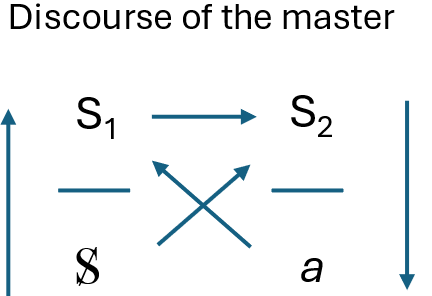
Lacanian practice, or, more specifically, Lacanian practice based on the ideas of the last Lacan – what Miller describes as the ‘Lacanian practice of the future’ – is somewhat different: it does not ‘work’. As Miller explains:
Lacanian practice fails. You recognise moreover, in this failing, a leitmotif of the last Lacan. He did everything he could to place himself in a position to fail with the [Borromean] knots. Obviously, this failing is not a contingent failing. This failing is the manifestation of the relation to an impossible.[9]
And this impossible is, of course, the Real. More specifically, if we follow Miller’s argument, this impossible manifests itself as surplus jouissance, which, in the discourse of the analyst, is in the dominant position (a) and ‘acts upon’ the divided subject ( ) as can be seen in the following schema:
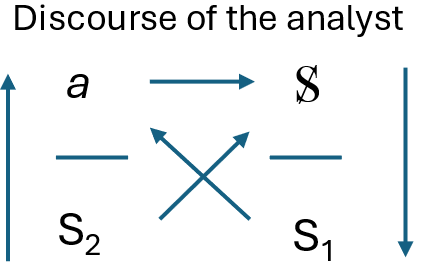
As Miller points out: “When we bar a letter, it is generally because we have made an error. Here, the surplus jouissance commands ‘it fails’ and precisely an ‘it fails’ in the sexual order.”[10] In other words, the  signifies that there is no sexual rapport. And herein lies the paradox of psychoanalysis and, more critically perhaps, the need for psychoanalysis to go ‘beyond’ itself. In his text Miller argues that psychoanalysis was invented as a response to a subjective discontent; a discontent with civilisation itself. A civilisation within which “…in order to give existence to the sexual relation, jouissance must be restrained, inhibited, repressed.” In other words, a civilisation where the discourse of the master reigns supreme. Psychoanalysis, on the other hand, “…paved the way to what was demonstrated – with all the quotation marks you want – as a liberation of jouissance.”[11] In other words, the ascendance of the object a, of surplus jouissance; both in cultural terms and in terms of the ‘rotation’ of the master’s discourse. Surplus jouissance now occupies the dominant position in our culture and is the driving force of our ‘civilisation’.
The essence of Miller’s argument seems to be that the ‘subversive’ nature of psychoanalysis is that of subverting the discourse of the master, which, ironically, paved the way for the emergence of hypermodern capitalism. However, one of the difficulties with such an argument is that is does not explain the ‘parallel’ emergence, so to speak, of another discourse: that of the university, which, as I discussed in my previous article, is also very much the dominant discourse of our time:
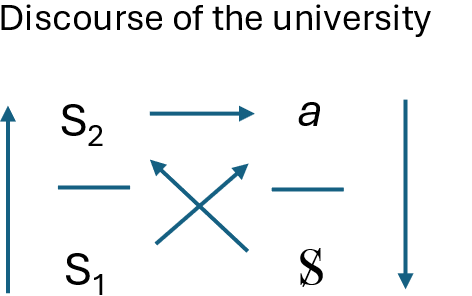
This is the discourse of technocracy, with knowledge in the dominant position. But doesn’t this somewhat undermine Miller’s argument that it is actually the analyst’s discourse that is now in the dominant position? In my view, no, because it has to be remembered that all four discourses, including that the hysteric, are all ‘versions’ of the discourse of the master. In other words, they are all, in essence, the same discourse; and, I would argue, the different ‘permutations’, which are effected through the rotation of the basic structure, are simply a way to give emphasise to specific terms and their relationships to other terms within the same basic structure.
An impossible choice
Where, though, does this leave psychoanalysis? Is it a matter of choosing between a psychoanalysis that ‘works’ in the form of ‘Freudian fundamentalism’, ‘nostalgia’ or ‘neuro-cognitivism’; or a psychoanalysis that ‘fails’? The short answer is ‘yes…but’: yes, analysts must choose…but it’s not quite that simple. Choosing a psychoanalysis that ‘works’ is, essentially, to carry on as before. But is this really a viable option anymore? To carry on as before is, if we follow the logic of Miller’s argument, to carry on propping up the status quo – which, of course, has always been one of the main critiques of psychoanalysis, especially from the Marxist camp. As a counterargument to this, one might point out that there is now a well-established tradition of ‘left-Lacanianism’, but there seems little evidence that this has had any impact of undermining or subverting the dominance of the master’s discourse (in all its forms). If anything, in the form of the discourse of the analyst, such a ‘left-Lacanianism’ has played its part in sustaining such a dominance.
But what of a psychoanalysis that fails? In some ways this seems a rather intriguing and somewhat paradoxical idea, especially as it appears to run counter to all the hopes and aspirations that have motivated many of those who have entered the field; including, I might add, myself. But what does it mean for psychoanalysis to ‘fail’? As I understand Miller’s arguments that I outlined earlier, the ‘failure’ of psychoanalysis is simply another way to state that psychoanalysis aims at the Real, at the impossible. But in that case, isn’t this simply a reinstatement of Freud’s proposition that psychoanalysis is one of the three impossible professions (the others being politics and education)? In other words, all analyses end in failure. However, this is simply a circular argument because ‘failure’ in this context means all analyses end by coming up against the Real; and perhaps those that don’t can’t really be described as analyses in the first place.
Perhaps one the difficulties here (the idea of psychoanalysis as ‘failing’ or as ‘failure’) is the way it is formulated. What I mean by this is that in the form of the analyst’s discourse, the ‘failure’ is written as a →  (in Miller’s words, surplus jouissance ‘commands’ the failure of the sexual relation). But at the same time, this failure appears to constitute the very ‘success’ of the discourse of hypermodern civilisation, that is, of hypermodern capitalism; which, according to Miller, is what the discourse of the analyst represents. In many ways this seems to undermine the strength, for want of a better term, of the ’failure’ of psychoanalysis; in other words, if the discourse of the analyst represents the ‘failure’ of psychoanalysis but the ‘success’ of capitalism then is this really a motivation to carry on ‘failing’?
But perhaps there is another way to formulate this ‘failure’, this encounter with the Real, and this is where the idea of ‘working in a hole of the Real’ becomes critical.
A hole in the Real?
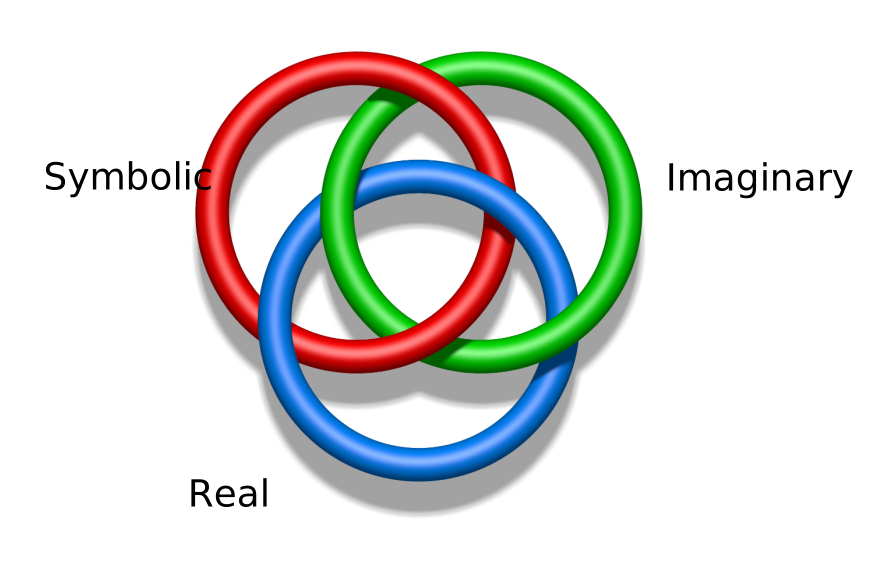
In Lesson eight of Seminar XXI Lacan makes reference to a ‘hole’ in the Real and through the use of a neologism defines this as a troumatisme, which conveys the idea of the trauma as a hole or wound: “But we all know, because all of us invent something to fill up the hole in the Real. Where there is no sexual relationship this gives a ‘troumatisme’”.[12] At this point I think it important to note that the idea of a ‘hole’ has a particular meaning here that may not apply elsewhere. This is because the ‘hole’ in question is constituted by Borromean rings, and such rings are but one (albeit well known) example of the topology of knots.[13] In fact, strictly speaking the concept of a ‘knot’ is misleading in this context; rather, the interlinking of the three rings that make up the ‘classic’ Borromean projection is an example of a Brunnian link:
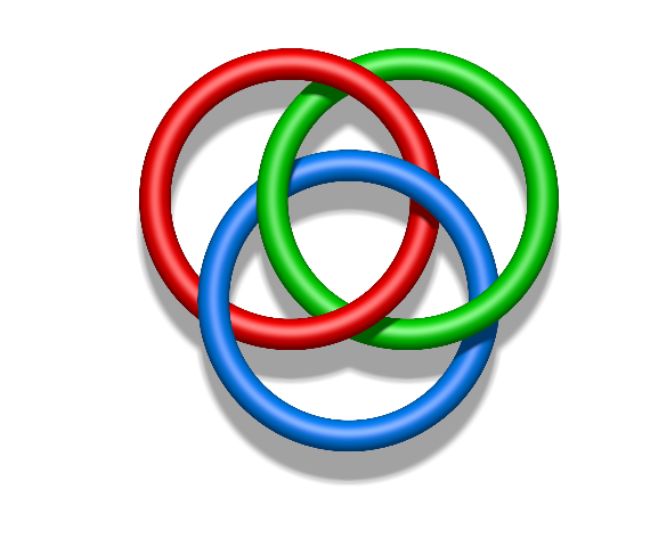
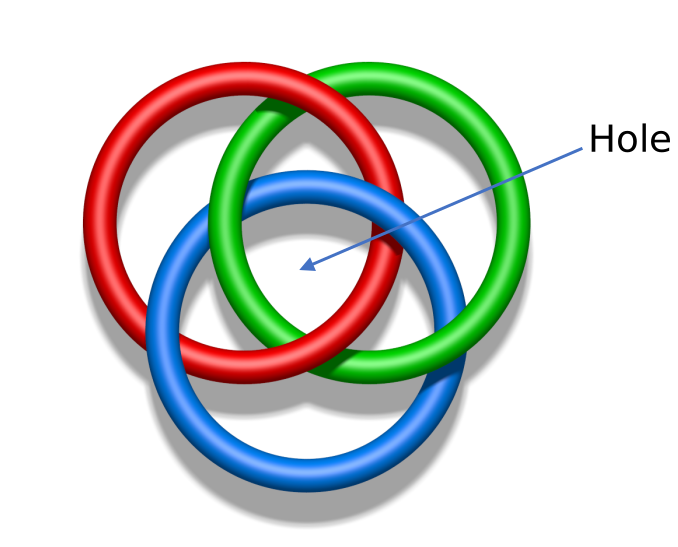
What this means is that although the three interlinked circles are inseparable, simply removing one of them results in the whole structure coming apart. And with regards to the concept of a ‘hole’, although, mathematically speaking each ring in itself contains a hole (because it cannot be reduced to single point), in Borromean topology the ‘hole’ is at the intersection of the three rings:
Although the Borromean knot (link) makes (relatively) brief appearances in Seminars XIX and XX, it is only in Seminar XXII (RSI) that it really takes centre stage.[14] And the RSI seminar, along with the following one (Seminar XXIII),[15] is, I would argue, the key text for any discussion or development of the ‘last Lacan’.[16] In Seminar XXII that it becomes clear that Lacan is moving beyond what might be best described as a ‘discursive’ theory of psychoanalysis and towards a purely topological and mathematically based theory. It is also important to note, as does Pierre Skriabine, that the Borromean knot is an attempt to theorise structure, the Symbolic, without a reference to the Other.[17] This essentially means we are beyond the theory of the four discourses, which are still rooted in the idea of the social bond and the existence of the Other. More precisely, according to Lacan, the knotting of the Real, Symbolic and Imaginary is the Other:
…if there is a real Other, it is nowhere else than in the knot itself and that is why there is no Other of the Other. This real Other, make yourselves identify yourself to its Imaginary, you have then the identification of the hysteric to the desire of the Other, the one that is happening here at this central point. Identify yourselves to the Symbolic of the real Other, you have then this identification that I specified as being the einziger Zug, the unary trait. Identify yourselves to the Real of the real Other, you obtain what I indicate as the Name-of-the-Father, and that is where Freud designated what this identification has to do with love.[18]
Another way to look at this is to see the Borromean approach as a focus on the structure of the subject itself, rather than on the subject’s relation to others.
But to return to the concept of a ‘hole in the Real’ and in order to get a better understanding of what Lacan is getting at it with his concept of the troumatisme, it is helpful to consider the following Borromean schema:

As can be seen from the schema, the troumatisme is at the intersection of the three ‘rings’ (Real, Symbolic, Imaginary) which is also the place of the object a (surplus jouissance). This shows, as I pointed out earlier, that, from a strictly topological perspective, the ‘hole’ is at the intersection of the three rings (registers). It also illustrates the difficulty in trying to represent visually something which is essentially beyond representation, that is, the Real.[19]
What, though, does it mean for the psychoanalyst to operate in the hole of the Real? If the analyst is to work in the ‘hole of the Real’ this implies that they are at the site of the object a. At first sight this seems to be simply another way of formulating the discourse of the analyst. However, as I’ve just argued the discourse of the analyst is essentially a formulation of the social bond and is also a variant of the discourse of the master, whereas the Borromean schema is a way to represent the structure of the subject itself. In other words, in Borromean terms the idea of the analyst being at the site of the object a (surplus jouissance, trauma) is radically different from the idea of the analyst taking up the position of the semblance of the object a, which is Lacan’s argument in Seminar XIX and which is illustrated in discursive terms in the discourse of the analyst.
Essentially, this is about the analyst being at or in the site of the subject’s trauma. But what does this mean in clinical terms? In other words, what does it mean in terms of the analyst being in the room (either physically, or, increasingly perhaps, virtually) with the subject? To start with, I would argue, this is not about the analyst taking up a position in relation to the subject, the analysand; as I’ve just noted, this is not a ‘discursive’ relationship. Rather, it is about the analyst being there, in the midst of the trauma, in the midst of the Real, with the analysand.
However, simply ‘being there’ is not in itself enough to establish an analytic relationship. For this to happen the analyst has to open up a space for the subject to bear the trauma (of the Real). And it should be clear at this point that the trauma in question is as much the trauma of the analyst as that of the analysand; it has to be because the analyst is right there in the hole of the Real (of the trauma) with the analysand. We can only hope that the analyst, through their own experience of being in analysis, is able to bear the trauma in order to keep open the space of the Real for the analysand.
Beyond psychoanalysis?
In what sense, though, can a psychoanalysis in the Real be described as being ‘beyond psychoanalysis’? In the sense that it goes beyond what Miller has described as the ‘what works’; and in doing so, I would argue, it goes beyond the discourse of the analyst. To be sure, the discourse of the analyst is itself a discourse of the failure of psychoanalysis, but at the same time it is the discourse of the success of hypermodern civilisation. On the other hand, a psychoanalysis of and in the Real is beyond discourse, beyond the social bond. This does not mean, however, that a psychoanalysis in the Real does not involve a human relationship, that is, between analyst and analysand. But a human relationship does not, necessarily, constitute a social bond, a discourse in the sense of Lacan’s four discourses. The social bond requires the existence (as opposed to the ek-sistence) of the Other, which is absent in the Borromean formulation. So a psychoanalysis in the Real, which according to Miller, ‘is (still?) to be invented’ operates outside the domain of the Other, outside the domain of discourse and, in many ways, outside or beyond everything that Lacan has stood for up until his ‘Borromean turn’.
Of course, in many ways, and for many analysts perhaps, it’s easier (and safer) just to carry on as before, to carry on with what ‘works’. And according to Miller this is precisely what many French (and other) analysts are doing. But is this really an option? Especially in a world that is increasingly turning against the status quo, against ‘business as usual’, where all the things we thought we knew are now being called into question – including what we thought we knew about psychoanalysis itself…
Notes and References
- https://therapeia.org.uk/ttr/2025/09/04/there-are-still-only-four-discourses/ ↑
- Jacques-Alain Miller, ‘A Fantasy’, Psychoanalytical Notebooks, no. 34 (December 2019), 158-59. ↑
- Miller, A Fantasy, 148-49. ↑
- Ibid., 150. ↑
- Eric Laurent, Lost in Cognition: Psychoanalysis and the Cognitive Sciences (Karnac, 2014). ↑
- Yves Vanderveken, ‘The Unconscious and the Brain: Nothing in Common’, The Lacanian Review, no. 09 (2020): 198–213. ↑
- Ibid., 152. ↑
- From: Stijn Vanheule, ‘Capitalist Discourse, Subjectivity and Lacanian Psychoanalysis’, Frontiers in Psychology 7 (2016). ↑
- Ibid., 153. ↑
- Miller, ‘A Fantasy’, 155. ↑
- Ibid., 157. ↑
- Jacques Lacan, The Seminar of Jacques Lacan : Book XXI : Les Non Dupres Errent: 1973-1974, trans. by Cormac Gallagher (Dublin: Unpublished translation by Cormac Gallagher, 2010), 151. (Hereafter Seminar XXI) ↑
- For a very readable introduction to knot topology see: Colin C. Adams, The Knot Book An Elementary Introduction to the Mathematical Theory of Knots (American Mathematical Society, 2001). ↑
- Jacques Lacan, The Seminar of Jacques Lacan Book XXII 1974-75: RSI, trans. Cormac Gallagher (Unpublished translation by Cormac Gallagher, 2011). ↑
- Jacques Lacan, The Sinthome: The Seminar of Jacques Lacan, Book XXIII, ed. Jacques-Alain Miller (Polity Press, 2016). ↑
- That is, the Lacan of the mid-1970s onwards. ↑
- Pierre Skriabine, ‘The Clinic of the Borromean Knot’, in Lacan: Topologically Speaking, ed. Ellie Ragland and Dragan Milovanovic (Other Press, 2004). ↑
- Lacan, Seminar XXII, 132. ↑
- As I understand it, the point ‘a’ in the 2D projection of the Borromean link it not strictly a ‘hole’ in the mathematical sense. Rather, it should be seen as a ‘structural’ hole where the Symbolic and Imaginary registers (that is, language) create a ‘hole’ in the Real. And to somewhat complicate things further, in Seminar XXIII Lacan argues that the Symbolic is itself a hole, but then argues that the ‘true hole’ is at the intersection of the Real and the Imaginary “…at the site where it is revealed that there is no Other of the Other.” (p.115). However, it is by no means clear if this is what Lacan means when he refers to a ‘hole in the Real’. It is also important to note that Lacan was continually revising his concept of the Borromean knot and its relation to the human subject right up until his death. ↑
The formalisation of the Borromean knots provides the scaffolding for a contemporary clinic of the Real. To explore further entries on the ‘very late Lacan’ and the status of the subject, please visit The Borromean Clinic Hub.
Last updated: April 7, 2026