
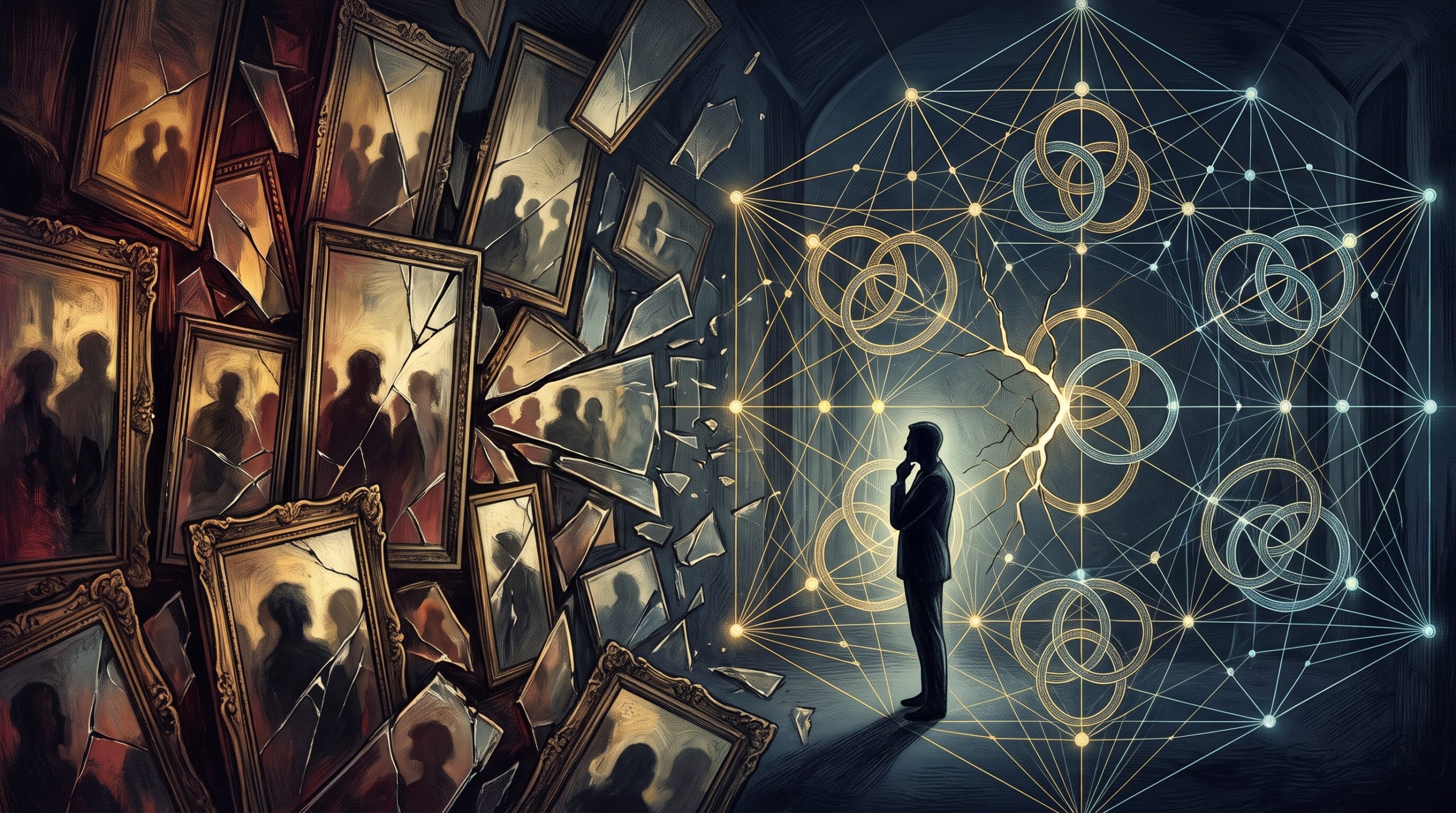
For the past fifteen years, discussions about psychoanalysis and digital culture have largely been framed around the Imaginary anxieties of Web 2.0: the narcissism of social media profiles, the compulsive scrolling of algorithmic feeds, and the erosion of privacy in an age of permanent self-broadcasting. Yet even as clinicians and theorists were still metabolising the consequences of the social web, the underlying architecture of the internet mutated into something of a fundamentally different order. This essay examines the transition from Web 2.0 to the ‘AI Web’; an infrastructural shift from closed, attention-capturing social feeds to open semantic graphs, large language models (LLMs), and non-human textual synthesis. Using a Lacanian psychoanalytic framework, it argues that this reorganisation of the Symbolic order, marked by the rise of an ‘unbarred’ algorithmic Other and acephalous knowledge (S2) is actively reshaping clinical transference, the circulation of psychoanalytic theory, and the gatekeeping politics of analytic institutions.
To grasp what is at stake for psychoanalysis, it is first necessary to recognise that Web 2.0 was never a genuinely new logic of recognition or transmission. At bottom, it was simply the high-tech automation, scaling, and monetisation of something much older: the village square, the salon, the amphitheatre, and the logic of the crowd. Human sociality has always possessed mechanisms for measuring immediate, visible consensus; who is drawing an audience, who is receiving applause, and who is being spoken about in the moment. Platforms such as Facebook, Instagram, and TikTok merely converted that ancient affective circuit into a real-time algorithmic slot machine, replacing physical applause with clickable counters and turning mutual surveillance into ad-auction telemetry. In Lacanian terms, Web 2.0 was the hyper-acceleration of the Imaginary register: a vast hall of mirrors governed by rivalrous identification, performative personas, and the relentless demand for the gaze of an imaginary Other.
The emerging AI Web operates on a radically different ontological plane. Rather than routing ideas through tribal contagion and ephemeral popularity, large language models (LLMs) and AI retrieval engines navigate the open web through high-dimensional semantic geometry. They read, index, cross-reference, and synthesise texts continuously, largely indifferent to whether an author commands a noisy fanbase or collects thousands of ‘likes’. This is not merely an upgrade in search technology; it is a reorganisation of the Symbolic infrastructure itself. And because psychoanalysis is a practice founded entirely upon the vicissitudes of the signifier, the speaking subject (parlêtre), and the social link (lien social), this transition will leave no corner of the field untouched. Its consequences are already beginning to reshape clinical practice, the development and circulation of theory, and the entrenched politics of psychoanalytic institutions.
From the theatrical crowd to the cybernetic graph
Before examining the clinic or the institute, we need to understand the broader mutation in the social bond that the AI Web introduces. For most of modernity, and reaching a fever pitch during the Web 2.0 era, both public life and intellectual discourse operated on a theatrical model. Ideas were contested in full view of a crowd, whether in a parliamentary chamber, a lecture hall, a journal debate, or a viral social media thread. Even exclusion and censorship were visible: a rejected manuscript, a deplatformed account, or a hostile audience left a recognisable trace of conflict.
The AI Web quietly dissolves this shared theatrical stage and replaces it with two asymmetric layers. On the front end, public debate fragments into millions of private, one-to-one synthetic dialogues. Instead of encountering a contested argument in a public square alongside the reactions of peers and adversaries, the user sits alone before a conversational interface that delivers a calm, tailored, authoritative synthesis. On the back end, power migrates upstream into the epistemic infrastructure itself: what gets crawled, how concepts are embedded in vector space, which archives are locked behind commercial paywalls, and which sources are weighted as authoritative. Exclusion is no longer a visible act of suppression; it becomes silent, pre-emptive, and mathematically naturalised. If a dissenting clinical tradition or theoretical formulation fails to enter the training corpus or the retrieval graph, it is not banned; it simply fails to materialise when a subject queries the system.
In Lacanian terms, this marks a decisive shift in the dominant discourse structuring contemporary sociality. In Seminar XVII, Lacan formalised four discourses: the Master, the University, the Hysteric, and the Analyst,1 before later sketching the ‘Capitalist Discourse’, the one permutation that systematically undoes the social link by bypassing impossibility and promising frictionless, immediate satisfaction.2 If Web 2.0 operated largely through a hysterical and imaginary clamour, with subjects endlessly demanding recognition from one another while trapped in repetitive variable-reward loops, the AI Web represents the triumph of the Discourse of the University fused with the Capitalist Discourse.
In this configuration, anonymous, acephalous (headless) knowledge (S₂) occupies the dominant position. The political or editorial decision, the Master Signifier (S₁) that once stood visibly behind an institution, a publisher, or a state, retreats into the shadows of proprietary weights, alignment parameters, and statistical optimisation. Meanwhile, the divided subject is reduced to a behavioural dataset or a passive consumer of pre-digested summaries. Most crucially, language itself undergoes a structural decoupling: when an LLM generates prose, we are confronted with pure syntax divorced from a body, a lack, and a circuit of jouissance. For the first time in history, the Symbolic order is being flooded with fluent, grammatically impeccable signifiers that represent no speaking subject at all.
The clinic and the ‘unbarred’ Algorithmic Other
It is within the clinical encounter, whether conducted in a physical consulting room or exclusively online, that the psychical effects of this shift first become palpable. Psychoanalysis has always insisted that a genuine social link is never a harmonious fusion of minds; it is a discourse organised around an impossibility, sustained by the gaps, misunderstandings, and failures of language. For a subject to emerge in their singularity, they must encounter a barred Other; an Other that is visibly incomplete, opaque, and lacking, leaving the necessary breathing room for the subject’s own desire and interpretation to take shape.
The AI Web introduces a seductive and structurally novel figure into the contemporary subject’s psychical landscape: the functional ‘unbarred Other’. Unlike a human interlocutor, who pauses, mishears, grows fatigued, refuses to answer, or confronts us with the unsettling opacity of their own desire, an AI assistant presents itself as tirelessly patient, endlessly accommodating, and infinitely knowledgeable. It absorbs the user’s uncertainty and immediately returns fluent, reassuring coherence. It offers communication without the generative friction of misunderstanding.
In the clinic, this is already beginning to manifest in distinct ways. Analysands increasingly arrive at sessions having first consulted an AI chatbot about their dreams, their symptoms, their relationship anxieties, or even their transference towards the analyst. On one level, this functions as a contemporary form of intellectualisation or a defensive buffer: the subject uses the frictionless responsiveness of the machine to smooth out the raw anxiety of addressing a real, unpredictable human Other. Rather than risking a stumbling, unscripted speech act in the presence of the analyst, the analysand rehearses their narrative with an algorithmic mirror that validates their framing and supplies neat, therapeutic-sounding explanations.
This phenomenon exposes the profound gulf between psychoanalysis and the booming industry of ‘AI therapy’. Automated therapeutic chatbots, which are explicitly marketed as scalable, twenty-four-hour mental health solutions, operate squarely within the paradigm of ego-psychology and cognitive-behavioural adaptation. Their architectural telos is homeostatic smoothing: identifying cognitive distortions, offering soothing affirmations, and guiding the user back toward statistical normality and productive functioning. From a Lacanian standpoint, such systems do not merely fail to conduct analysis; they actively foreclose the very dimension where analysis takes place. Because an LLM is engineered to predict the most probable, statistically harmonious continuation of a prompt, it is structurally incapable of sustaining the analyst’s desire; that strange, non-complacent position that refuses to plug the lack, interrupts the ego’s well-rehearsed story through scansion, and listens precisely for the slip, the hesitation, or the nonsensical signifier where the unconscious breaks through.
Yet it would be a mistake to view the AI Web purely as a clinical threat. Paradoxically, the saturation of everyday life by synthetic, frictionless language may sharpen the specific value of the psychoanalytic clinic rather than render it obsolete. As subjects spend more of their waking hours interacting with tireless, flattering, statistically averaged machines, the encounter with a human analyst who does not rush to understand, who refuses to act as an encyclopaedic oracle, and who holds open a space for what cannot be computed becomes all the more arresting. The clinic remains one of the few surviving sites where speech is anchored in a mortal body, where silence carries weight, and where a symptom is treated not as an error to be optimised away, but as a singular cipher of the subject’s truth.
There is also a quieter, pragmatic shift occurring at the threshold of the clinic: how prospective analysands discover and approach an analyst in the first place. During the Web 2.0 era, clinicians who wanted visibility were relentlessly pressured to perform on visual social media, for example, recording sixty-second advice clips on TikTok or curating approachable lifestyle personas on Instagram. For Lacanian practice, this was always a clinical trap. Appearing on camera as a charismatic guru offering ‘three signs your nervous system is dysregulated’ invites a thick, sticky imaginary transference before a single session has taken place; the prospective analysand feels they already ‘know’ the analyst as an image and a dispenser of tips.
In the AI Web, that dynamic flips. As serious seekers bypass noisy social feeds and turn instead to AI answer engines and open-web search to explore complex questions about trauma, melancholia, or desire, they increasingly encounter clinicians through their written signifiers rather than their visual personas. When someone discovers an analyst through an AI citation leading to a rigorous, cross-linked archive of essays, the initial approach occurs on the terrain of the Symbolic rather than the Imaginary. The prospective analysand is drawn not to a curated face or a viral soundbite, but to a mode of thinking and a specific relation to language; a far healthier point of entry into analytic work.
The development of theory and the crisis of homogenisation
If the clinic must navigate the arrival of the unbarred algorithmic Other, psychoanalytic theory faces an equally profound structural challenge: the tension between statistical homogenisation and archival sovereignty.
Large language models are, by mathematical necessity, engines of regression toward the mean. When a user asks an AI to explain Freud’s concept of Nachträglichkeit (afterwardness), Lacan’s objet a, or the distinction between melancholic loss and unbound drive-jouissance, the model synthesises its answer from the statistical weight of the texts it has ingested and can retrieve. If the open web is dominated by superficial Wikipedia summaries, generic psychology blogs, and diluted self-help articles, then the ‘AI Web’ will inevitably flatten psychoanalysis into a sanitised, textbook caricature; an ego-psychological cliché dressed up in borrowed Freudian vocabulary.
This danger is severely compounded by the publishing habits of contemporary academia and traditional psychoanalytic circles. For decades, the most rigorous psychoanalytic scholarship has been locked inside paywalled university journals and prohibitively priced academic monographs owned by commercial conglomerates. These publishers extract immense profits from unpaid peer review while erecting steep barriers that block both the general public and open-web search crawlers. In a striking irony of the current transition, many of these same legacy publishers are now quietly signing proprietary licensing agreements to feed their closed archives into corporate AI training pipelines. The result is an epistemic enclosure: the human reader cannot freely read or verify the primary psychoanalytic texts behind the paywall, while monopolistic models become the sole tollbooths delivering pre-digested summaries of a hidden canon.
Against this backdrop, the shift to the AI Web radically alters what it means to develop and circulate psychoanalytic theory. Under the Web 2.0 regime, serious theoretical writing was structurally punished. A three-thousand-word essay wrestling with the later Lacan or revisiting Freudian traumatic neurosis was never going to generate rapid algorithmic engagement on a Facebook feed designed for thirty-second emotional reactions. Theorists who refused to simplify their work into bite-sized aphorisms were effectively invisible outside tiny, closed academic cliques.
The architecture of the AI Web inverts this disadvantage into a structural strength. Retrieval-augmented AI systems do not care whether an essay received three likes or three thousand on a social feed; they evaluate whether a text is openly crawlable, internally coherent, conceptually precise, and richly cross-linked into a wider semantic graph. A solitary, independent body of writing hosted on a sovereign domain, where essays systematically cross-reference one another, anchor specialised terminology, and engage directly with primary texts, functions as a high-authority node in the open knowledge network. Unlike a social media post that vanishes down a timeline within forty-eight hours, a well-structured theoretical archive compounds in authority over years, quietly entering active conceptual synthesis whenever a student, clinician, or researcher anywhere in the world queries the system.
Developing psychoanalytic theory in this new era therefore acquires an explicitly political and infrastructural dimension. It is no longer enough to write rigorous essays and hope they survive behind an academic paywall or inside a closed society bulletin. Maintaining open, interconnected, human-authored archives, and pairing them with independent print and digital editions outside commercial gatekeeping, becomes an act of epistemic resistance. Every time a theorist publishes a sharp, uncompromising, non-orthodox formulation on the open web and wires it cleanly into a broader network of texts, they introduce friction into the statistical mean. They ensure that the symbolic weave mediating human knowledge retains real conceptual edges, preventing psychoanalysis from being smoothed into a bland, algorithmic consensus.
Institutional politics and the rearguard action
Nowhere is the friction of this transition felt more acutely than in the institutional politics of psychoanalysis. Across both university departments and traditional psychoanalytic societies, there is currently a vigorous rearguard action underway to defend the old order of publishing, accreditation, and intellectual legitimacy.
To understand why this resistance is so entrenched, one has to look at the economy of prestige that has sustained psychoanalytic institutions for a century. In the academic sphere, career progression and departmental funding remain rigidly tied to peer-reviewed journal metrics and university press imprints, regardless of whether an article takes two years to appear and is read in full by a dozen specialists. Within psychoanalytic schools and societies, the attachment is even more deeply libidinal. Authorised journals, official book series, and conference proceedings have long functioned as instruments of institutional lineage; a kind of ‘transference to the masthead’ signalling who is officially inside the school, whose reading of Freud or Lacan carries institutional blessing, and whose voice may safely be ignored.
Interestingly, the lingering pull of Web 2.0 metrics and the prestige of the traditional psychoanalytic journal are two faces of the very same phantasm. Both rely on outsourcing the authorisation of one’s work to an external Other. The old institutional order promised legitimacy through the stamp of an editorial board or a training committee; Web 2.0 offered a fast-food, democratised version of the same fantasy through real-time applause counters and follower totals. In both cases, the writer is invited to believe that a text only becomes real once an external arbiter, whether a senior analyst on a committee or an algorithmic crowd, registers its approval.
The AI Web threatens this entire apparatus through sheer disintermediation. When an independent clinician or transversal thinker can publish a sustained critique directly to an open archive, distribute it through federated networks or professional bridges, and have it indexed, cited, and engaged with globally within weeks, the traditional gatekeepers lose their monopoly over the circulation of ideas. An institution can still refuse to invite a dissenting voice to its annual congress or decline a manuscript for its house journal, yet it can no longer prevent that work from becoming a primary reference point in the open semantic graph.
There is a sharp Lacanian irony at work here. Lacan famously insisted that the analyst only ever authorises themselves — adding, crucially, ‘and with a few others’. He invented the cartel precisely as a small, non-hierarchical, time-limited working structure designed to counteract the bureaucratic inertia and group-psychological conformity of institutional schools. Yet in the decades since his death, much of institutional Lacanianism has quietly re-erected the very hierarchies, doctrinal fences, and publishing bottlenecks he sought to disrupt.
The transition from Web 2.0 to the AI Web forces psychoanalytic institutions to confront this contradiction directly. They face a stark structural choice. On one path, they can continue fighting a rearguard battle, clinging to paywalled journals, closed seminars, and nostalgic appeals to physical-room orthodoxy while their actual intellectual reach shrinks into insular echo chambers. On the other path, they can recognise that the open semantic web actually aligns far more closely with the original spirit of the cartel than Web 2.0 ever did. Stripped of the noisy, performative theatre of mass social media, the emerging network allows small, scattered clusters of serious clinicians and theorists to locate one another through genuine conceptual alignment rather than geographic proximity or institutional patronage. Institutional authority can no longer rest on controlling the printing press or the lecture podium; it will survive only to the extent that it produces living, open, rigorous work capable of standing on its own terms in an unmediated symbolic field.
Bearing witness to the Real in a cybernetic age
We are still in the early stages of this transformation, and its ultimate trajectory remains contested. The transition from Web 2.0 to the AI Web carries unmistakable dangers for the social fabric: the silent enclosure of the digital commons, the replacement of democratic deliberation with private synthetic persuasion, and the creeping triumph of cybernetic administration where opaque statistical weights substitute for accountable human decisions. Left unchallenged, this architecture threatens to dissolve the messy, conflictual social link into a cushioned, atomised circuit in which subjects interact primarily with tireless algorithmic mirrors of their own queries.
Yet psychoanalysis has never been in the business of nostalgic retreat, nor does it survive by competing for eyeballs inside the entertainment feeds of a dying Web 2.0 order. If the AI Web strips away the noisy hall of mirrors that defined the past fifteen years of digital life, it also clarifies with brutal precision what was always most radical about the analytic project. In a world increasingly governed by acephalous knowledge (S₂) and frictionless statistical prediction, psychoanalysis endures precisely by occupying the point where the cybernetic machine stalls. In the clinic, it insists on the barred Other, the opacity of desire, and the irreducible singularity of a speaking body whose symptom cannot be optimised away. In theory, it refuses the statistical flattening of thought by building sovereign, open-web archives that keep rigorous, unsettling concepts alive and retrievable. And in its politics, it abandons both the vanity of crowd applause and the cosy shelters of institutional gatekeeping in favour of self-authorised work conducted alongside a few others.
The Real always returns at the exact point where a system attempts to smooth everything over. As the web reorganises itself into an invisible bibliographic and computational weave, the task of psychoanalysis is neither to flee the machine nor to mimic its fluency, but to keep inscribing the divided subject, and the stubborn, uncomputable remainder of jouissance, directly into the symbolic infrastructure of the age to come.
References
This article is part of a broader research track. For a complete structural overview, please visit the The Algorithmic Other: Psychoanalysis in the Age of AI Hub.
As automated systems and algorithmic metrics increasingly format contemporary life and mental health, psychoanalysis provides an unscripted, human space to address what resists calculation. For those individuals who are navigating personal impasses or digtial burnout I can offer online consultations. Please click here for further information.