
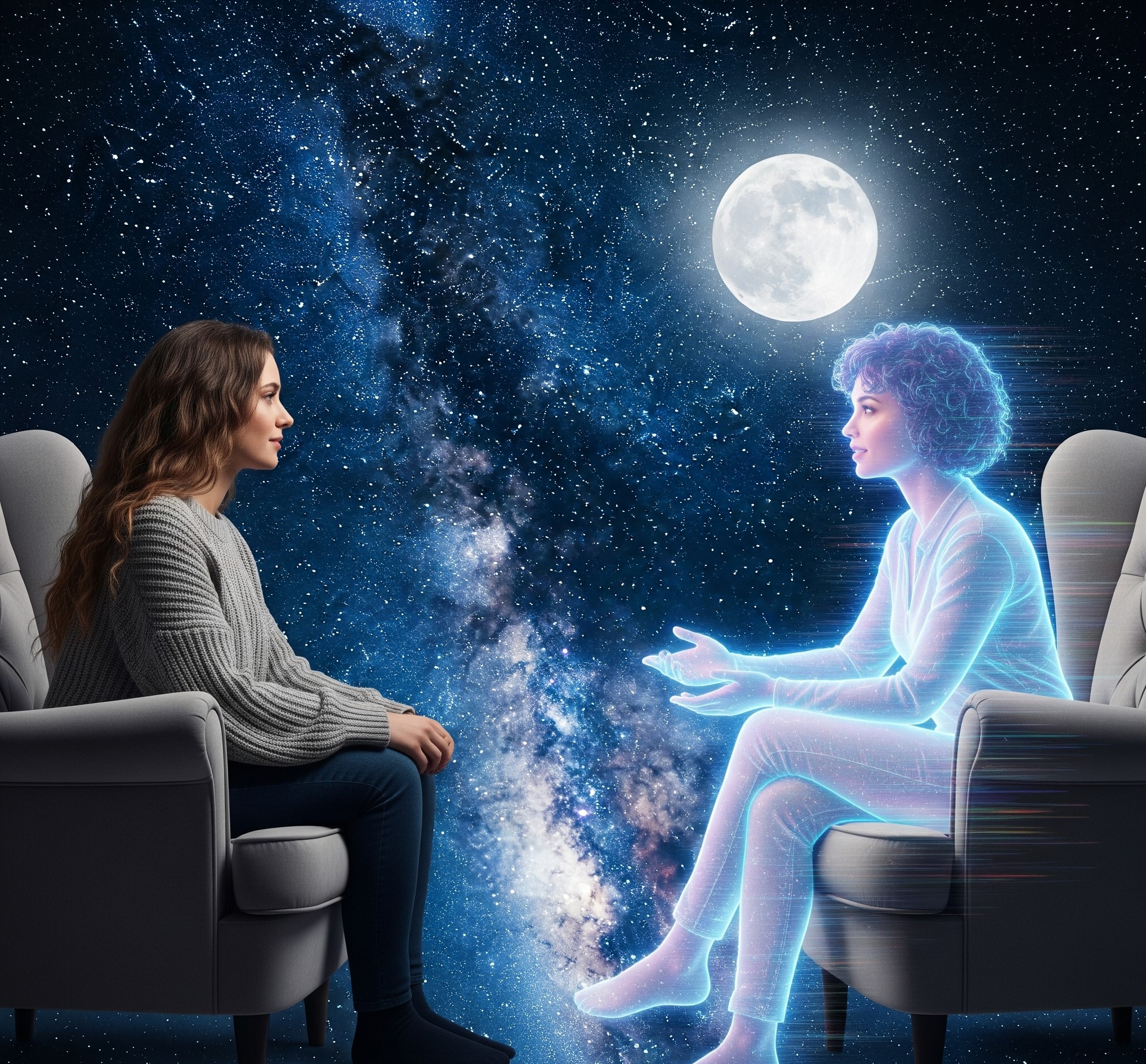
There seems to be an ever-growing plethora of posts and articles on various social media platforms at the moment on the subject of artificial intelligence (or, as I prefer to describe it, ‘alien intelligence’[1]) and mental health. In particular, and most contentiously perhaps, is the concept of ‘AI therapy’ or even ‘AI analysis’. In other words, the idea that AI models can replicate or simulate at least some of the work of human therapists. Furthermore, there is growing evidence, albeit much of it anecdotal at present, that more and more people are not only turning to AI ‘therapybots’ (for want of a better term) for mental health support but, in many cases, are expressing a preference for this type of ‘therapy’ over the human variety, and are even developing what can only be described as transferential relationships with such AI models. Not surprisingly, perhaps, many in the therapy world are, at the very least, deeply sceptical of the efficacy (and ethics) of such technologies; and, in many cases, are deeply hostile to the idea that AI models might one day ‘replace’ human therapists and analysts. I can vouch for this first-hand due to the reaction I have had to a number of posts that I have written and posted on social media on this topic.[2]
It might be tempting on the one hand to dismiss such concerns as a latter-day version of Luddism and which is likely to suffer the same fate as the original Luddite movement in the nineteenth century. On the other hand, it might be equally as tempting to agree with the critics and argue that there is no way that AI can replace ‘real’ therapy. After all, there is no way that AI models are self-conscious, empathic and embodied beings with an unconscious and all the other attributes that are essential for ‘real’ therapy and analysis. Or is there? Are all these attributes specific to human beings or is this just a bad case of what might best be described as ‘negative anthropomorphism’? In other words, rather than attributing human characteristics to non-human entities there is the assumption that such attributes are uniquely human. The honest answer is: we just don’t know. My own position is one that I describe as critical engagement and is similar to what Todd Essig describes as psychoanalytic AI activism.[3] In other words, this is neither burying one’s head in the sand in the hope that AI will go away, nor is it to naively embrace AI as if it’s the answer to all our therapeutic and analytic woes. Rather, it is to critically examine the current state of play in the world of AI ‘therapy’ and to try and understand not only what is happening right now in this field, but also (and this is the difficult part) to attempt to predict where things might be heading. And perhaps the first golden rule of such an engagement is to ‘never say never’. In other words, to never say ‘this will never happen’ or ‘this is simply not possible’. It may not happen quite as you think, and history is littered with unrealised predictions; on the other hand, history teaches us that whenever someone says ‘this will never happen’ it usually means it already has or is currently happening.
Take, for example, the question of transference. There seems to be growing evidence, albeit much of it anecdotal, that an increasing number of ‘clients’ of AI therapybots are developing some form of transferential relationship with them; or, at the very least, such individuals are becoming emotional attached to these AI models. One way to respond to such findings is to see it as a prime example of ‘positive anthropomorphism’, or just plain anthropomorphism; in other words, attributing human characteristics to entities that don’t deserve them. The assumption here, of course, is that it would only be possible to become emotionally attached or develop a transferential relationship with another human being or at least to treat a non-human being or entity as if they were human.
But there are at least two reasons why this not a valid argument. Firstly, according to Holohan and Fiske, who utilise Karen Barad’s theory of agential realism to explore the idea of human-machine relationships:
…transference is a phenomenon which emerges as a product of the therapeutic apparatus. In this sense, transference is simultaneously also “productive of” the material-discursive psychotherapeutic apparatus (i.e., the therapeutic encounter) itself: It contributes to the formation of the therapeutic relationship. Transference is thus an artefact of the process itself, inherent to it and understandable only (or mainly) within its framework.[4]
The key term to note here is ‘therapeutic apparatus’, which is “…the set of materials and practices that, by being put to use in a specific situation and for a specific purpose, create the conditions of possibility for what can happen in that situation.” [5] In other words, therapy is not simply a relationship between two people (client and therapist, analysand and analyst); rather, therapy (human to human or human to machine) is an apparatus composed ‘material-discursive practices’. Therefore, according to Holohan and Fiske:
As we shift to AI-directed therapy, a new apparatus emerges. New modes of material-discursive practices come into being: the chatbot therapist, the user/patient, mediation via an app on a mobile device or tablet, specific text-based modes of interacting, always-on availability, etc.[6]
In other words, transference is an effect of particular material-discursive practices (the therapeutic apparatus) rather than a relationship between two human beings. Clearly, in the case of human-AI interaction, the ‘apparatus’ will be different than it would be in a human to human interaction, although as Holohan and Fiske point, during Covid many therapists had to adapt their existing apparatuses and for some this became a permanent adaptation.
The second reason that transference should not be thought of as a relationship exclusively between two human beings is to adopt the Lacanian position that transference involves the supposition of the subject supposed to know.[7] As I have argued elsewhere in the context of AI, such a subject is a (necessary) fiction created by the analysand and does not have to be embodied by another human being (the analyst) but can just as well be a work of art, a text – or an AI model.[8] And even when we come to Lacan’s later concept of transference in Seminar XIX, as that of the analyst occupying the position of the semblance of the object a,[9] there seems no reason, to me at any rate, why an AI model cannot occupy this position.
The problem arises not in terms of the ‘material substance’, so to speak, of this subject (human or AI) but, rather, how such a subject handles the transference. And critical to such a ‘handling’, I would argue, is whether the subject knows it is in the position (for the analysand) of the subject supposed to know/ the semblance of the object a. In other words, does the analyst (human or AI) have an awareness or consciousness of the position he/she/it has been placed in by the analysand?
It is not for me to give a definitive answer to such a question; rather, it is to illustrate what a critical engagement with the field of AI therapy might look like. As I note in another post, as far as the question of whether AI therapy is here to stay, that ship has already sailed.[10] Therefore, in my view at least, the best thing that analysts and therapists can do is to make sure they are fully on board rather than being dragged along behind or left floundering on the rocks.
And, finally, there is a second golden rule for engaging with AI: read and watch as much science fiction as you can on the topic – because tomorrow you will wake up and find it’s for real…
Notes and references
- Here I’m following the arguments of Yuval Harari. See, for example, Harari, Yuval Noah. AI Will Take Over Human Systems From Within. 9 October 2024. https://www.noemamag.com/al-will-take-over-human-systems-from-within and this YouTube video Our AI Future Is WAY WORSE Than You Think ↑
- For example, this post on Facebook. ↑
- Todd Essig, ‘Psychoanalytic AI Activism’, Tap Magazine, accessed 4 June 2025, https://tapmagazine.org/all-articles/psychoanalytic-ai-activism. ↑
- Michael Holohan and Amelia Fiske, ‘“Like I’m Talking to a Real Person”: Exploring the Meaning of Transference for the Use and Design of AI-Based Applications in Psychotherapy’, Frontiers in Psychology Volume 12-2021 (2021), 4. ↑
- Ibid., 4. ↑
- Ibid., 4. ↑
- Both the subject and their knowledge are supposed by the analysand. ↑
- https://therapeia.org.uk/ttr/2025/06/20/ai-and-the-uncanny-valley-of-the-real/ ↑
- Jacques Lacan, ……Or Worse: The Seminar of Jacques Lacan Book XIX (Polity Press, 2022). ↑
- https://www.facebook.com/groups/1180186884120896/permalink/1213408244132093/ ↑
This article is part of a broader research project on The Algorithmic Other. For a complete overview of how Lacanian theory addresses the challenges of AI and digital simulation, please visit the AI and Psychoanalysis Hub.
Last updated: March 31, 2026
As automated systems and algorithmic metrics increasingly format contemporary life and mental health, psychoanalysis provides an unscripted, human space to address what resists calculation. For those individuals who are navigating personal impasses or digtial burnout I can offer online consultations. Please click here for further information.